Product teams are drowning in data but short on answers. AI data analysis tools promise to close that gap — letting you query your warehouse, surface KPI changes, and generate dashboards without waiting on a data analyst. These tools take different approaches to the same problem.
How we evaluated
Ranked on natural language query accuracy, data source coverage, team collaboration features, pricing transparency, and fit for product and GTM workflows. Enterprise security requirements and self-serve accessibility for non-technical users were both weighted.
Hex
Hex combines AI-powered notebooks, conversational self-serve analytics (Threads), and data apps in a single platform with shared context. Analysts write code, business users ask questions in plain English, both working from the same semantic layer. Used by Anthropic, Figma, Ramp, and Reddit.
Strengths
- Genuinely unified: notebooks, BI, and conversational AI in one system with shared semantic context
- Threads agent handles plain-English questions without requiring analyst involvement
- Generous free Community tier for individuals and small teams
- Deep warehouse integrations covering Snowflake, BigQuery, Databricks, ClickHouse, and Redshift
- MCP server support for Claude and Cursor integration
Limitations
- Per-seat pricing adds up at scale — Team tier is $75/editor/month
- SSO, audit logs, and HIPAA support are Enterprise-only (custom pricing)
- Credit-based AI usage can hit limits for heavy analytical workloads
Fabi.ai
Fabi.ai is explicitly built for product, GTM, and data teams — not just analysts. Smartbooks combine SQL, Python, and no-code in a single collaborative document. The integration list covers PostHog, Stripe, HubSpot, Supabase, and dbt alongside major warehouses, which is unusually broad for this category.
Strengths
- Explicitly built for product and GTM workflows, not just data analysts
- Smartbooks support SQL, Python, and no-code in the same document for mixed-skill teams
- Broadest integration list in the category: PostHog, Stripe, HubSpot, Supabase, Google Analytics, and major warehouses
- MCP server support for external LLM and chat integration
- Affordable per-seat pricing ($39–$50/seat) for small-to-mid teams
Limitations
- Free tier limited to 25 AI requests/month — effectively a short trial
- App connectors cost an additional $100/connector/month on the Builder plan
- Smaller community and track record than Hex or Julius AI
Julius AI
Julius AI has 2M+ users and a proven track record for natural language data analysis across spreadsheets, databases, and cloud storage. It supports Python, R, and SQL for advanced users and offers a Slack agent for team-wide data access. Enterprise customers include Nvidia and Zapier.
Strengths
- Natural language interface works well — no SQL or coding required for common queries
- Supports Python, R, and SQL for power users who want to go deeper
- Slack Agent enables team-wide automated reporting and in-channel data queries
- SOC 2 Type II, GDPR, and TX-RAMP compliant
- Large proven user base (2M+) with documented enterprise case studies
Limitations
- Free tier is nearly unusable at 5 messages/month
- Business ($450/mo) and Growth ($750/mo) plans are expensive for smaller teams
- Credit-based usage makes cost-per-analysis hard to predict at scale
Product Analyst
Still digging through dashboards?
Ask any product data question and get answers in seconds — no SQL, no waiting.
Try Product Analyst — Free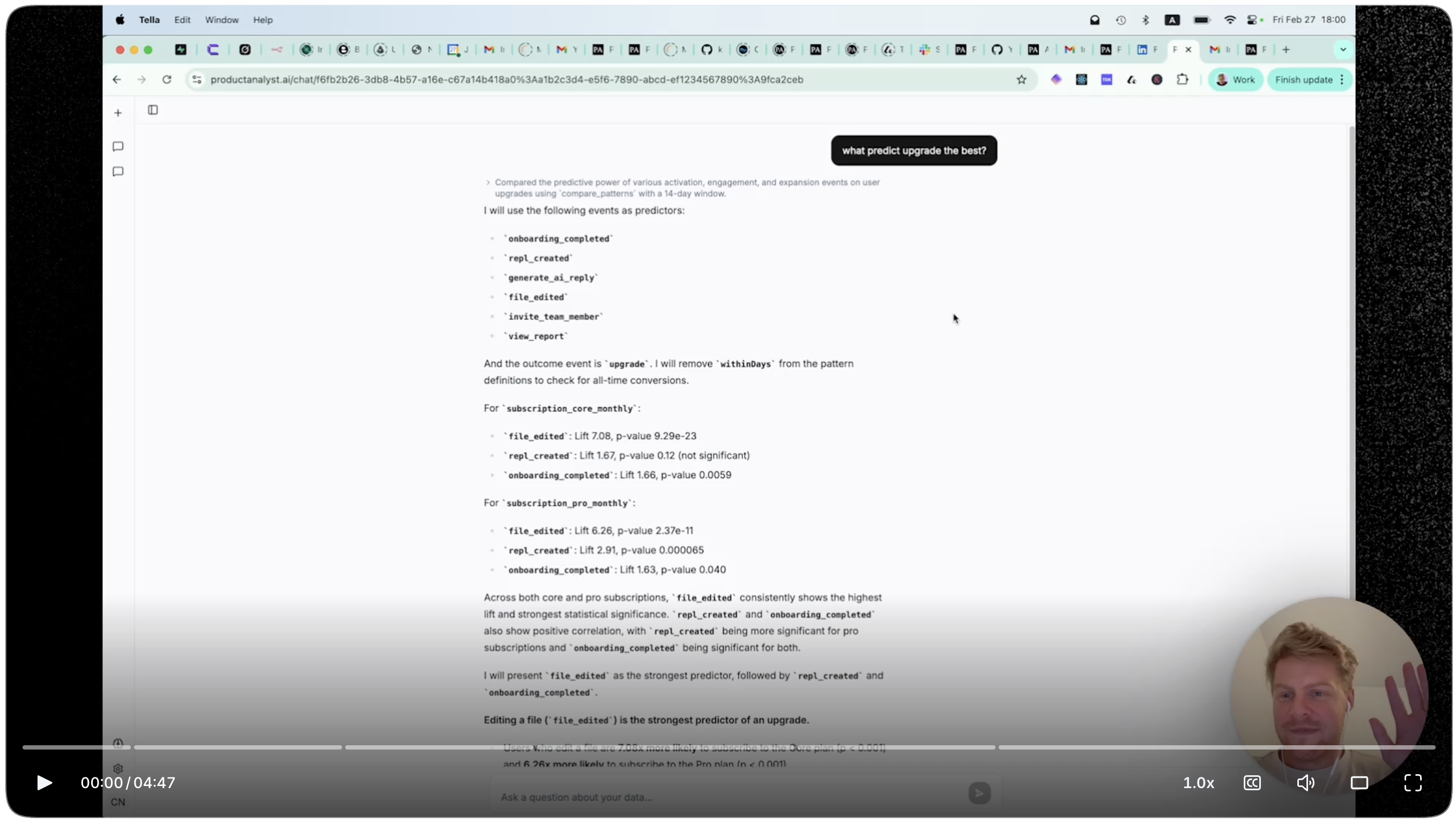
Dot
Dot is built on the premise that data questions should be answered where teams already work — Slack, Teams, and email. It connects to your warehouse, writes SQL, generates charts, and delivers executive-ready PowerPoint reports on schedule. Claims 90% accuracy on 450+ financial analysis tasks.
Strengths
- Works directly in Slack and Microsoft Teams — no context switching for stakeholders
- 90% accuracy on 450+ financial analysis tasks is a concrete, documented benchmark
- Automated PowerPoint report generation on schedule reduces analyst time on recurring decks
- Context Agent auto-syncs metric definitions from Tableau, Snowflake, and Confluence
- SOC 2, GDPR, row-level security, and SSO available on Team plan
Limitations
- Credit-based pricing ($1.80/credit on Pro) gets expensive at high query volumes
- No ongoing free tier — 300 one-time credits only, then paid plans required
- SSO and row-level security require the $720/mo Team plan
TextQL
TextQL deploys AI data analyst agents designed for complex, multi-source environments — where data is spread across multiple warehouses and SaaS tools and doesn't conform neatly. Trusted by Amazon, Dropbox, and the NBA. Supports on-prem and air-gapped deployments, which is rare in this category.
Strengths
- Designed for messy, multi-source enterprise data — not just clean single-warehouse queries
- Generous free tier: $100/mo in credits with 3 seats and full feature access
- HIPAA, SOC2, and GDPR compliant with on-prem and air-gapped deployment options
- Multi-LLM support (Claude, Gemini, OpenAI) with custom model fine-tuning at Enterprise tier
- Ontology builder ensures shared business metric definitions across the team
Limitations
- Usage-based compute pricing is less predictable than flat per-seat models
- Smaller community and ecosystem than established BI platforms
- Enterprise features — dedicated infrastructure, custom models — require sales negotiation
Loops
Loops uses proprietary causal inference models to identify why KPIs change — not just that they changed. It detects root causes, measures product release impact without A/B tests, and surfaces hidden user segments. Used by Monday.com, ClickUp, Postman, and AB InBev.
Strengths
- Causal inference approach explains why metrics change, not just surface-level correlation
- Measures feature release impact without A/B tests — practical for low-traffic products
- Documented case studies showing 20–200% lifts in key metrics
- No-code setup with dedicated onboarding assistance
- Trusted by recognized product companies including Monday.com, ClickUp, and Postman
Limitations
- No public pricing — enterprise/demo-only model blocks smaller teams entirely
- Narrowly focused on KPI causation, not general-purpose data querying or analysis
- Limited public documentation on specific data source integrations
Product Analyst
Product Analyst provides AI-powered signals, account health scores, churn risk, and expansion potential for B2B SaaS teams. It works as an agentic layer on top of existing tracking tools (Mixpanel, Amplitude, PostHog) rather than replacing them — surfacing what your stack already collects but doesn't proactively signal.
Strengths
- Purpose-built for B2B SaaS product and customer success workflows
- Works alongside existing analytics stacks — no migration or replacement required
- Automated health scores and churn signals without manual dashboard building
- Focused on retention and expansion signals, not just raw activity metrics
- Free tier available for evaluation without a sales call
Limitations
- Newer product with a smaller track record than established tools in this list
- Focused exclusively on B2B SaaS — not suited for B2C, e-commerce, or general data analysis
- Narrower scope than general-purpose AI analytics platforms
Graphed
Graphed connects to 750+ data sources and bundles a managed data pipeline and cloud data warehouse — no separate infrastructure required. Aimed at growth and marketing teams who want instant dashboards from natural language with zero technical setup or maintenance overhead.
Strengths
- 750+ data source connectors is genuinely the broadest in this comparison
- Fully managed infrastructure: pipeline, warehouse, and semantic layer included
- No technical setup — connects and queries in plain English
- MCP server support for Claude Code, Cursor, and Windsurf
- Includes a dedicated cloud data warehouse at no additional cost
Limitations
- No free tier beyond a 14-day trial
- Pro starts at $500/mo — high entry price for small or early-stage teams
- No enterprise tier listed; unclear path for large organizations with security requirements
Sequel
Sequel is a lightweight AI BI tool aimed at founders and small teams who want to query their database in plain English without a data team. At $19/user/month for the Professional plan, it's the most affordable paid option in this category. Self-hosted deployment is available for security-conscious teams.
Strengths
- Most affordable paid option at $19/user/month
- Free tier available with no credit card required
- Self-hosted deployment for teams with data residency or security requirements
- Supports modern edge databases (Cloudflare D1, TursoDB) alongside standard options
- Clean, minimal UI with a low adoption curve
Limitations
- No Slack integration yet — listed as coming soon
- Not suited for enterprise needs: no SSO, RBAC, or audit logging
- Professional plan is limited to 1 user; Team plan requires custom pricing negotiation
Userlens
Userlens is a churn prediction and account intelligence tool for B2B SaaS customer success teams. Its AI agents monitor every account continuously, predict churn months in advance, and surface signals proactively. It pulls from Mixpanel, Amplitude, PostHog, and CRMs rather than replacing them.
Strengths
- Purpose-built for CS teams with account-level intelligence rather than generic dashboards
- AI agent monitors accounts continuously and surfaces churn risk without manual checks
- Deep integrations with Mixpanel, Amplitude, PostHog, Salesforce, and HubSpot
- Compare mode enables quick side-by-side feature usage analysis across accounts
- White-glove onboarding and consultation included in every plan
Limitations
- No free tier; Growth plan starts at $500/month
- Growth plan capped at 50 tracked companies — restrictive for larger CS portfolios
- SOC 2 Type 2 certification still in progress
The Verdict
Hex is the strongest all-around platform for data teams that need analyst-grade notebooks and self-serve BI in one system. Fabi.ai is the better pick for product and GTM teams given its native PostHog, Stripe, and HubSpot connectors. Julius AI suits teams that prioritize wide adoption over depth. Dot wins for Slack-first organizations.
Frequently Asked Questions
- What's the difference between AI analytics tools and traditional BI tools like Tableau or Looker?
- Traditional BI tools require analysts to pre-build dashboards and write SQL. AI analytics tools let anyone ask questions in plain English and get answers on demand. The tradeoff: AI tools are faster for ad hoc analysis but can produce inconsistent results without well-maintained semantic layers or context tuning.
- Which AI data analysis tool is best for non-technical product managers?
- Julius AI and Graphed are the most accessible — both handle natural language queries without any SQL knowledge. Fabi.ai and Dot also offer no-code interfaces alongside SQL and Python for mixed-skill teams. Hex is powerful but assumes some technical context from analysts.
- Can these tools replace a data analyst?
- For ad hoc questions and standard reporting, they reduce the bottleneck significantly. They struggle with complex business logic, nuanced metric definitions, and novel analysis patterns. Most product teams use them to handle routine queries so analysts focus on higher-value work.
- Which tool has the best Slack integration?
- Dot is purpose-built around Slack and Teams delivery, including automated scheduled reports. Julius AI's Slack Agent supports in-channel queries and automated reports. TextQL and Fabi.ai also integrate with Slack, but Dot's integration is the most developed of the group.
- What's the most affordable AI analytics tool for a small team?
- Sequel is the most affordable at $19/user/month for Professional, with a usable free tier. Fabi.ai is $39/seat/month with a free Starter tier. Julius AI is $20/month per individual. For small teams wanting team features without paying per seat, Hex's free Community tier covers up to 5 notebooks.
- Which tools connect to Snowflake, BigQuery, and Databricks?
- Hex, Julius AI (Business and Growth plans), TextQL, Dot, and Fabi.ai all support Snowflake, BigQuery, and Databricks. Graphed and Sequel also support Snowflake and BigQuery. Note that Julius AI gates warehouse connectors behind the $450/mo Business plan.
- Is there an AI analytics tool that works without migrating my data?
- Most tools in this list connect to your existing warehouse or databases in place — no migration required. They query your data where it already lives. Product Analyst specifically works as an add-on layer over Mixpanel or Amplitude. Graphed is the exception: it provides its own managed data warehouse.
- Which tool is best for measuring product feature impact?
- Loops is specifically designed for measuring feature release impact using causal inference, including without A/B tests. For broader product analytics with AI assistance, Fabi.ai and Hex offer the best combination of product data connectors and analytical flexibility.
- Which tools have enterprise security features like SSO and audit logs?
- TextQL (Team plan), Dot (Team plan), Hex (Enterprise), Julius AI (Business and Growth), and Userlens (Enterprise) all offer SSO. Audit logs are typically Enterprise-tier across all platforms. TextQL uniquely offers HIPAA compliance, on-prem deployment, and air-gapped options.
- Do I need to replace my existing analytics tools to use these platforms?
- No — most work alongside existing tools. Fabi.ai, TextQL, and Dot connect to your current warehouse and BI setup without replacing it. If you want automated signals and health scores on top of your analytics stack, productanalyst.ai adds an AI layer that works alongside any of these tools.