Amplitude is capable, but its Growth and Enterprise plans are custom-priced — and many teams don't need everything it includes. Whether you're looking to cut costs, move to usage-based pricing, or get AI-driven analysis instead of traditional dashboards, there's a strong alternative for every use case.
How we evaluated
Tools were evaluated on product analytics depth (funnels, retention, cohorts), pricing transparency at scale, AI capabilities, and team fit. Direct Amplitude replacements were weighted differently from AI analysis tools that serve different use cases entirely.
PostHog
PostHog is an open-source product analytics platform built for product engineers. It covers analytics, session replay, feature flags, A/B testing, surveys, error tracking, and a managed data warehouse in one product with transparent usage-based pricing.
Strengths
- Extremely generous free tier: 1M analytics events, 5K session recordings, and 1M feature flag requests per month with no credit card required
- Open-source and self-hostable for teams that need full data control or data residency requirements
- Usage-based pricing with per-product billing caps to prevent surprise invoices
- Covers more surface area than Amplitude: error tracking, LLM analytics, and a managed data warehouse included
- Developer-friendly with MCP support, extensive API, and technically literate support staff
Limitations
- Usage-based pricing is harder to forecast for high-volume applications compared to a fixed monthly bill
- SSO enforcement and advanced RBAC require paid platform add-ons starting at $250/mo
Mixpanel
Mixpanel is a product analytics platform focused on event-based behavioral analysis. It's one of the most established tools in the space, with deep funnel, cohort, and retention analysis, plus session replay tied directly to analytics data and a natural language query builder.
Strengths
- Generous free tier with 1M events/month and unlimited seats — no per-seat pricing on any plan
- Deep event-based analytics with powerful cohort segmentation and multi-touch attribution
- Session replay connected directly to analytics data, making funnel debugging faster
- Spark AI query builder translates natural language questions into analytics reports
- Flexible data warehouse connectors (Snowflake, BigQuery, Redshift) with no vendor lock-in
Limitations
- Growth plan overage pricing at $0.28 per 1K events adds up quickly at scale
- Metric Trees and A/B experimentation are Enterprise-only features requiring a sales conversation
Hex
Hex is an AI analytics platform that combines data notebooks, conversational self-serve analytics (Threads), and interactive data apps in one system. It's built for data teams that need to go deeper than dashboards, with SQL, Python, and AI agents working together in a shared environment.
Strengths
- Combines notebooks, BI, and AI agents in a single platform — code-first analysis for analysts, plain-language Threads for stakeholders
- Agentic notebook handles code generation, chart creation, and debugging without context switching
- Deep warehouse integrations with OAuth support across Snowflake, BigQuery, and Databricks
- MCP server support for Claude and Cursor integration in existing workflows
- Trusted by Anthropic, Notion, Figma, Ramp, and Reddit — strong signal on data team adoption
Limitations
- Per-editor pricing ($36-75/mo) gets expensive as the team grows
- SSO, audit logs, and HIPAA compliance are Enterprise-only, requiring custom pricing
Product Analyst
Still digging through dashboards?
Ask any product data question and get answers in seconds — no SQL, no waiting.
Try Product Analyst — Free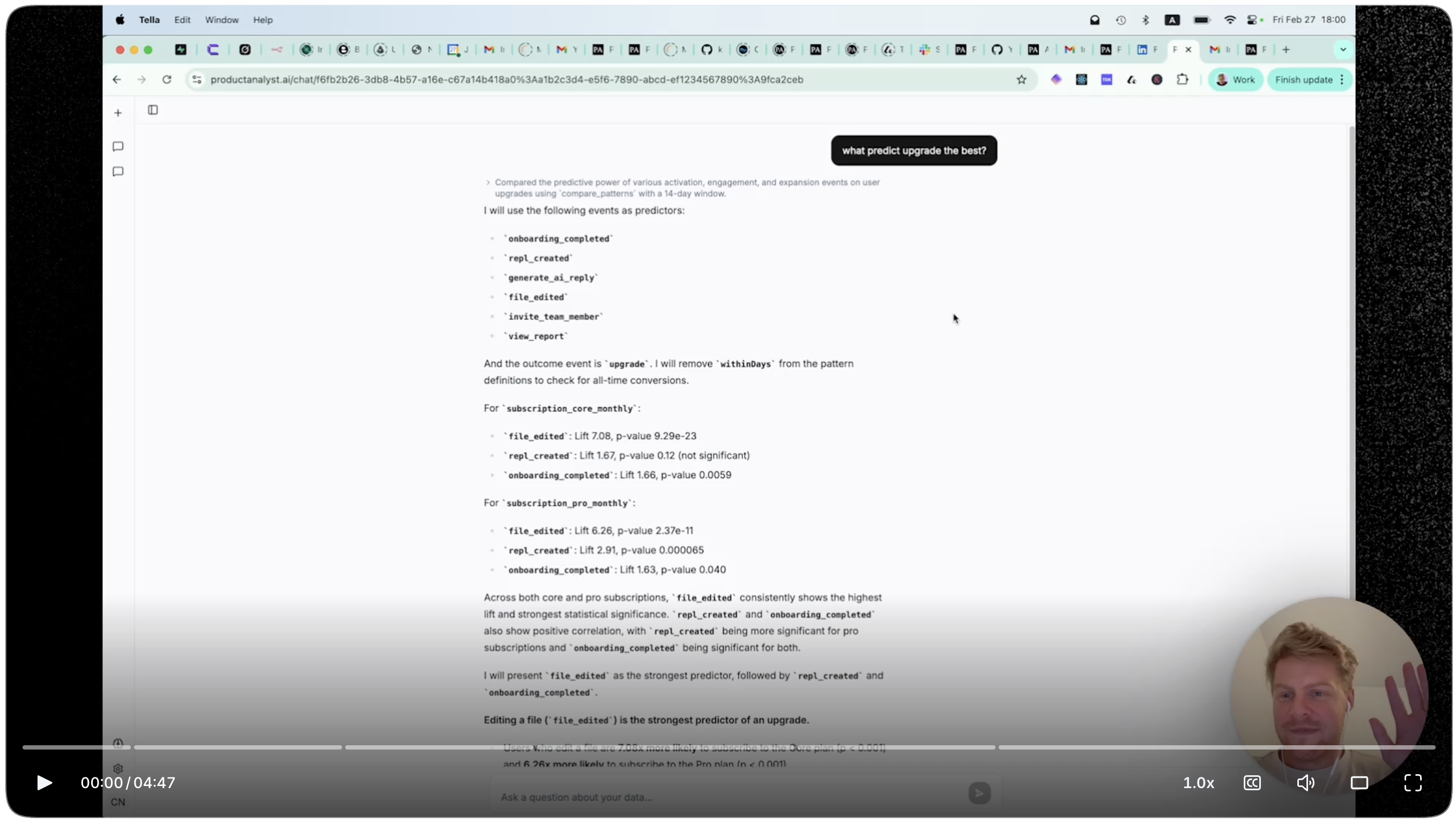
Julius AI
Julius AI is a natural language data analysis platform for teams that need insights from spreadsheets, databases, and cloud storage without writing code. It generates charts, forecasts, and automated reports through a chat interface, with Python, R, and SQL available for users who want to go deeper.
Strengths
- Natural language interface requires no SQL or coding knowledge — ask a question, get a chart or forecast
- Supports Python, R, and SQL code execution for analysts who need more control
- SOC 2 Type II, GDPR, and TX-RAMP compliant with strong enterprise security posture
- Slack integration enables automated report delivery to specific channels or users
- 2M+ user base with proven case studies from Nvidia, Zapier, and enterprise companies
Limitations
- Free tier caps at 5 messages/month — barely enough to evaluate the product
- Business ($450/mo) and Growth ($750/mo) plans are expensive relative to competing BI tools
- Credit-based usage system can be opaque for teams trying to budget predictably
Fabi.ai
Fabi.ai is an AI-native BI platform for product, GTM, and data teams. It combines SQL, Python, and no-code interfaces in AI-powered Smartbooks, with a broad integration set spanning product analytics, CRM, and data warehouses — all in one collaborative workspace.
Strengths
- Combines SQL, Python, and no-code in a single interface — works for engineers and non-technical users on the same document
- Broad integration ecosystem including PostHog, Stripe, HubSpot, Supabase, and 25+ others beyond standard warehouses
- MCP server support for LLM integration with external chat interfaces
- Affordable per-seat pricing for small teams at $39-50/seat
- Scheduled dashboards and automated workflows reduce manual reporting overhead
Limitations
- Free tier caps at 25 AI requests/month and 5 Smartbooks — fills up quickly in active use
- App connectors cost an additional $100/connector/month on the Builder plan, which adds up fast
Loops
Loops is an AI analytics platform built around causal inference. Instead of showing you what changed, it explains why. It automatically detects KPI drops, finds root causes, and measures the impact of product releases without requiring A/B tests.
Strengths
- Causal inference modeling goes beyond correlation to explain why metrics changed, not just that they did
- Measures feature release impact without A/B testing — valuable for low-traffic products or when holdout groups aren't feasible
- Automated KPI drop detection and alerting with no-code setup reduces time to awareness
- Proven ROI with documented case studies from Monday.com, ClickUp, Postman, and AB InBev
- No-code setup with dedicated onboarding support included
Limitations
- No public pricing — enterprise/demo-only model makes it inaccessible to smaller teams without a sales process
- Narrowly focused on KPI analysis and causal inference — not a general-purpose replacement for Amplitude's breadth of features
Product Analyst
Product Analyst is an AI-powered analytics tool built for B2B SaaS teams. It generates automated signals through account-level health scores, churn risk indicators, and expansion potential scores, functioning as an agentic layer on top of your existing tracking tools rather than replacing them.
Strengths
- Account-level health scores and churn risk signals purpose-built for B2B SaaS revenue and retention workflows
- Works alongside existing tools — adds AI signals on top of Amplitude, PostHog, or Mixpanel without requiring migration
- Expansion potential scoring surfaces upsell opportunities automatically, without manual cohort analysis
- Free tier available for smaller teams evaluating the product
Limitations
- Newer product with a smaller community and less documentation than established analytics tools
- B2B SaaS focus makes it less relevant for B2C, consumer apps, or event-driven product teams
- Not a standalone Amplitude replacement — intended as a complementary AI signals layer, not a full analytics platform
The Verdict
PostHog is the strongest all-around Amplitude replacement for most teams — especially where pricing transparency matters. Mixpanel is the closest feature match for teams with established event tracking. Hex and Loops serve teams that need deeper analysis or causal attribution beyond dashboards. For B2B SaaS teams, Product Analyst layers health scores and churn signals on top of whichever tool you pick.
Frequently Asked Questions
- What is the best free alternative to Amplitude?
- PostHog and Mixpanel both offer genuinely useful free tiers. PostHog's free plan includes 1M analytics events, 5K session recordings, and 1M feature flag requests per month. Mixpanel's free plan covers 1M events/month with unlimited seats. Both require no credit card to start and cover most early-stage needs.
- How does PostHog compare to Amplitude?
- PostHog covers more surface area — it adds error tracking, LLM analytics, and a managed data warehouse that Amplitude doesn't include. Amplitude has a more polished UI for non-technical stakeholders and stronger AI-powered analysis features. PostHog is open-source with self-hosting; Amplitude is cloud-only. PostHog's usage-based pricing is more predictable than Amplitude's custom-priced Growth and Enterprise tiers.
- Is Mixpanel cheaper than Amplitude?
- Yes, at comparable volumes. Mixpanel's Growth plan is free up to 1M events, then $0.28 per additional 1K events, with no seat limits. Amplitude's Plus plan starts at $49/mo, but Growth and Enterprise are custom-priced. Mixpanel's overage model is more predictable for teams that know their event volume in advance.
- Which Amplitude alternative is best for small teams?
- PostHog is the most generous for small teams — over 90% of companies use it entirely on the free tier. Mixpanel's free plan with unlimited seats is also strong. Fabi.ai at $39/seat and Julius AI at $20/mo are affordable options if your team needs AI-driven analysis rather than traditional event tracking.
- Can I replace Amplitude with an open-source tool?
- PostHog is the most direct open-source replacement. It's MIT licensed and self-hostable, giving you full data control. It covers all core Amplitude use cases — analytics, session replay, feature flags, and experiments — and is actively maintained with a large community. The cloud-hosted version is available if you prefer not to manage your own infrastructure.
- Which tool handles A/B testing and experimentation best?
- PostHog includes experiments on its free tier with feature flags and web experimentation up to 50K impressions/month. Amplitude's Feature Experimentation is solid but locked behind the custom-priced Growth plan. Mixpanel's experimentation requires the Enterprise plan. For teams that want to measure release impact without a formal A/B test setup, Loops uses causal inference as an alternative.
- What if I need analytics without writing any code?
- Julius AI and Fabi.ai are built for this. Julius lets you ask questions in plain English against spreadsheets and databases and generates charts and forecasts. Fabi.ai provides a no-code interface alongside SQL and Python for mixed teams. Both are better suited for ad hoc data analysis than the event-tracking model that Amplitude, PostHog, and Mixpanel are built on.
- Are there Amplitude alternatives built specifically for B2B SaaS teams?
- Amplitude and Mixpanel both handle B2B SaaS analytics well, but neither includes account-level health scoring out of the box. Product Analyst (productanalyst.ai) is purpose-built for B2B SaaS product and CS teams — it surfaces churn risk, account health scores, and expansion signals automatically, and is designed to work alongside your existing analytics tool rather than replace it.
- Which tool is best for diagnosing why a metric dropped?
- Loops is the strongest option here. It uses proprietary causal inference models to explain why KPIs changed and can measure the impact of specific product releases without a holdout group or A/B test. Mixpanel's Enterprise plan includes anomaly detection and root cause analysis, but Loops goes significantly deeper on causal attribution.
- Do any of these tools work with AI assistants like Claude or ChatGPT?
- Several tools now support MCP (Model Context Protocol): PostHog, Hex, Fabi.ai, and Mixpanel all have MCP integrations for AI agent access to your data. Amplitude also supports MCP. If you want automated signals and health scores on top of your analytics stack, productanalyst.ai adds an AI layer that works alongside any of these tools.