GA4 was built for marketing attribution — it tracks sessions, acquisition channels, and conversions for Google Ads. If your team needs funnel analysis, retention cohorts, or user-level behavioral data without fighting sampling limits and a 14-month retention cap, you need a different tool. Here are the best alternatives built for how product teams actually work.
How we evaluated
Tools were evaluated on event-based tracking depth, funnel and retention analysis, pricing transparency, free tier generosity, and how well they serve product teams rather than marketing teams. GA4's core pain points — data sampling, short retention, complexity, and marketing-first design — informed what to look for in replacements.
PostHog
PostHog is an open-source product analytics platform that bundles analytics, session replay, feature flags, A/B testing, surveys, and a managed data warehouse in one system. Its transparent usage-based pricing and genuinely generous free tier (1M events/month) make it the strongest default choice for product teams replacing GA4.
Strengths
- Free tier covers 1M analytics events, 5K session recordings, and 1M feature flag requests — no credit card required
- All-in-one platform replacing multiple tools: analytics, session replay, feature flags, A/B tests, surveys, and error tracking
- Open-source (MIT licensed) with a self-hosting option for teams that need full data sovereignty
- Transparent usage-based pricing with per-product billing limits so you can cap spend before it surprises you
- Developer-friendly with extensive SDK support, MCP integration, and technically literate support staff
Limitations
- Usage-based pricing is hard to forecast for high-volume applications — budget planning requires modeling your event volume
- Advanced platform features like RBAC and SSO enforcement require paid add-ons ranging from $250 to $2,000/mo
Amplitude
Amplitude is a mature product analytics platform combining analytics, session replay, web analytics, and experimentation in a unified suite. It goes deeper than GA4 on behavioral analysis, with ML-powered predictive audiences and a startup scholarship that makes enterprise-grade tooling accessible early.
Strengths
- Comprehensive suite combining product analytics, session replay, feature flags, and A/B experimentation in one platform
- AI capabilities include predictive audiences, AI Feedback for customer sentiment analysis, and session replay summaries
- Free Starter plan covers 10K MTUs and up to 10M events including session replay and feature flags
- Startup scholarship provides one free year of the Growth plan for companies with under $10M in funding
- 150+ integrations spanning data warehouses, CDPs, ad platforms, and marketing automation tools
Limitations
- MTU-based billing becomes expensive at scale; advanced features like cross-product analysis and Feature Experimentation are locked behind custom-priced Growth and Enterprise plans
- Steeper learning curve than simpler tools — the breadth of the platform can be overwhelming for smaller teams
Mixpanel
Mixpanel focuses on event-based product analytics with strong funnel, retention, and cohort analysis. Its free tier is among the most generous at 1M events/month with unlimited seats, and the Spark AI query builder lets anyone on the team ask data questions without writing SQL.
Strengths
- 1M events/month free with unlimited seats — one of the most usable free tiers in product analytics
- Clean, focused interface with powerful segmentation, behavioral cohorts, and multi-touch attribution
- Spark AI query builder for natural language analytics (30 queries/month on free, 60 on Growth)
- Session replay tied directly to analytics data for debugging user drop-off without switching tools
- Flexible data warehouse connectors (Snowflake, BigQuery, Redshift) with no proprietary lock-in
Limitations
- Growth plan overage pricing at $0.28 per 1K events accumulates quickly once you exceed 1M events/month
- Metric Trees, anomaly detection, root cause analysis, and experimentation features require the Enterprise plan
Product Analyst
Still digging through dashboards?
Ask any product data question and get answers in seconds — no SQL, no waiting.
Try Product Analyst — Free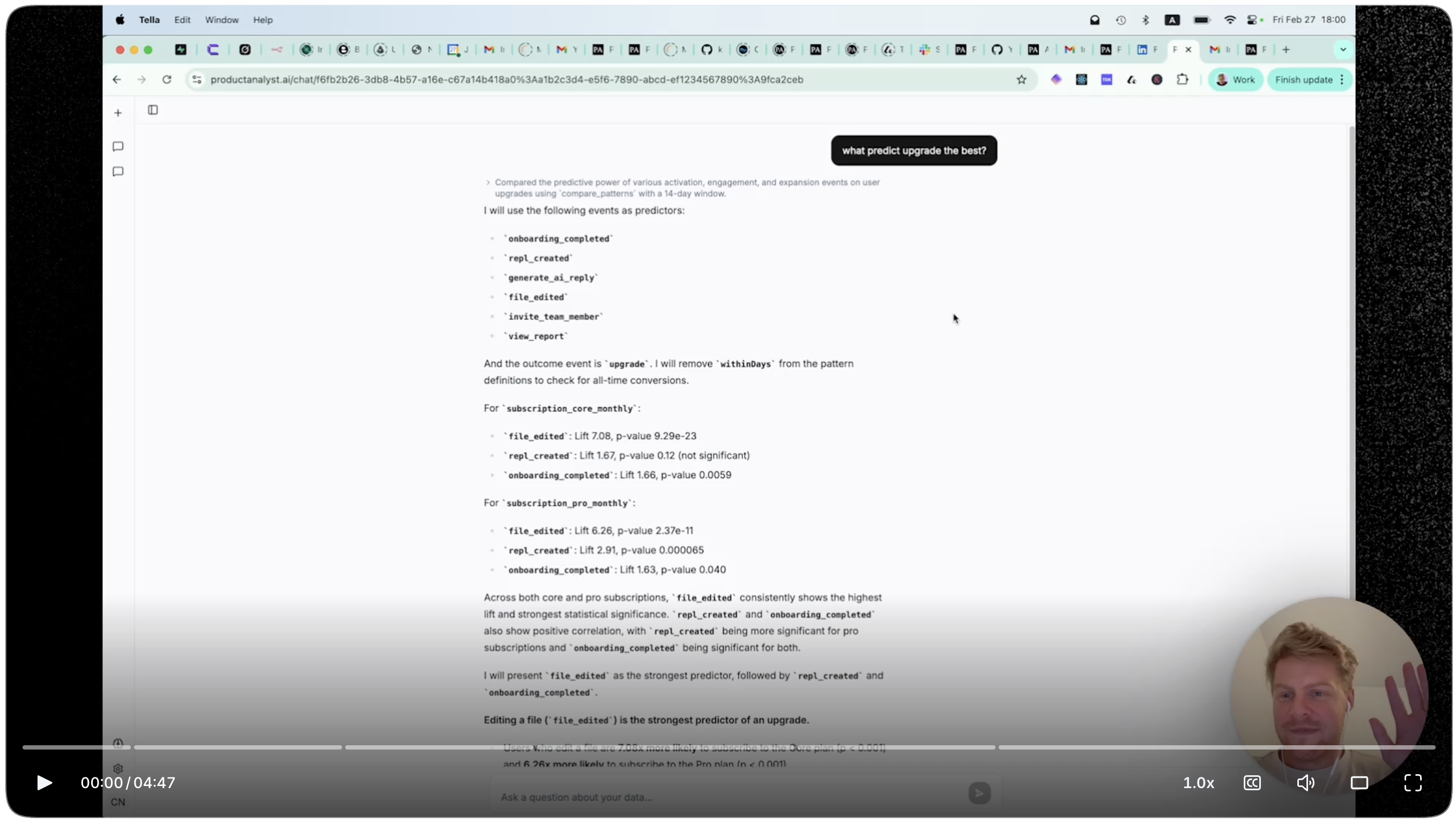
Hex
Hex combines AI-powered data notebooks with conversational self-serve analytics in one platform. It's not a drop-in GA4 replacement — it's an upgrade for data teams who've outgrown dashboards and need code-level analysis alongside plain-language querying for non-technical stakeholders.
Strengths
- Agentic notebooks with SQL, Python, and visualization cells give analysts full flexibility for deep ad-hoc work
- Conversational Threads feature lets non-technical teammates ask questions in plain English without SQL
- Strong warehouse integrations (Snowflake, BigQuery, Databricks) with OAuth support
- Free Community tier supports up to 5 notebooks with no time limit — useful for solo analysts or small teams
Limitations
- Not a direct GA4 replacement — lacks event tracking, session replay, and behavioral cohorts out of the box
- Per-seat pricing at $36–$75/mo per editor scales expensively for larger teams, and SSO requires custom Enterprise pricing
Product Analyst
Product Analyst is an AI-powered analytics layer built for B2B SaaS teams. Rather than replacing your tracking stack, it sits on top — generating account-level health scores, churn risk signals, and expansion potential from your existing data. It addresses a different question than GA4: not what pages users visit, but which accounts are at risk.
Strengths
- AI-generated account health scores and churn risk signals without writing queries or building custom dashboards
- Account-level analytics built for B2B SaaS, where the unit of analysis is a company account, not a pageview
- Expansion opportunity identification to surface accounts showing signals of readiness for upsell
- Works alongside existing tracking tools (Amplitude, PostHog, Mixpanel) rather than forcing a full migration
Limitations
- Newer product with a more limited track record than established platforms
- B2B SaaS focus makes it a poor fit for consumer apps, e-commerce, or marketing attribution use cases
The Verdict
PostHog is the strongest direct GA4 replacement for product teams — open-source, all-in-one, and genuinely usable at $0. Amplitude wins for enterprise teams needing experimentation depth and ML-powered audiences. Mixpanel is the focused, self-serve option for event analytics without the overhead. If you're running a B2B SaaS product and want revenue-oriented signals that none of these provide natively, Product Analyst fills that gap as an add-on layer.
Frequently Asked Questions
- What's the main difference between GA4 and product analytics tools like Amplitude or Mixpanel?
- GA4 is built for marketing measurement — tracking sessions, acquisition channels, and conversions tied to Google Ads spend. Product analytics tools like Amplitude and Mixpanel are built around user behavior: who did what, in what sequence, and what drove them to convert or churn. GA4 has exploration reports, but they're secondary to its marketing focus and subject to data sampling on the free tier.
- Is GA4 free? Are the alternatives also free?
- GA4 standard is free with generous limits (10M events/day), but unsampled reporting and enterprise features require GA4 360 which starts at approximately $50,000/year. Most alternatives have free tiers: PostHog (1M events/month), Mixpanel (1M events/month with unlimited seats), and Amplitude (10K MTUs and 10M events). Pricing models differ — Amplitude uses MTUs, PostHog uses per-event usage pricing, and Mixpanel charges per-event overages.
- Can I migrate historical data from GA4 to a different tool?
- Not directly — event schemas are incompatible between GA4 and tools like PostHog or Mixpanel. You can export GA4 raw data via BigQuery and transform it, but the process is complex and rarely worth the effort. Most teams run both tools in parallel for 30–90 days, then cut over once core reports are rebuilt in the new platform and stakeholders trust the numbers.
- Which GA4 alternative has the best free tier for startups?
- PostHog's free plan is the most feature-complete: 1M analytics events, 5K session recordings, 1M feature flag requests, and A/B testing — with no credit card required. Mixpanel's free tier gives 1M events/month with unlimited seats, which covers most early-stage products. Amplitude's Starter plan includes 10K MTUs with session replay but is more restrictive on saved charts and projects.
- Does PostHog fully replace GA4?
- For product analytics use cases, yes. PostHog covers event tracking, funnel analysis, retention, session replay, feature flags, and experimentation. What it doesn't replicate is GA4's deep integration with Google Ads, Google Search Console, and Search Ads 360. If paid search attribution is a primary reporting requirement, many teams keep GA4 running in parallel specifically for that use case.
- Is data sampling a problem with GA4 alternatives?
- Data sampling is a GA4-specific issue — it applies to exploration reports on the free tier when query complexity or data volume exceeds internal thresholds. Amplitude, PostHog, and Mixpanel do not sample data in standard reports. GA4 360 removes sampling but costs approximately $50,000/year. Switching to any of the alternatives listed here eliminates sampling as an ongoing concern.
- What's the data retention difference between GA4 and the alternatives?
- GA4 free tier caps retention at 14 months (configurable to 2 or 14 months). GA4 360 extends this to 50 months. PostHog's pay-as-you-go plan offers 7-year retention. Mixpanel Enterprise has a customizable retention policy. Amplitude Growth and Enterprise plans include unlimited data access. For long-term cohort analysis, any paid tier of these alternatives outperforms GA4 standard on retention.
- Which tool is best for B2B SaaS product analytics specifically?
- Amplitude and Mixpanel both support account-level analytics (group analytics), making them viable for B2B SaaS where the unit of measure is a company rather than an individual user. PostHog also offers group analytics as a paid add-on. For teams that want to go beyond behavioral tracking into automated health scores, churn prediction, and expansion signals, Product Analyst provides that as an AI layer on top of any existing analytics stack.
- Can I use multiple analytics tools at the same time?
- Yes, and many teams do. A common setup: PostHog or Mixpanel for product analytics, GA4 alongside for Google Ads attribution, and a warehouse (BigQuery, Snowflake) for raw data access. Tools like Segment or RudderStack fan out a single event stream to multiple destinations so you don't instrument twice. If you want automated signals and health scores on top of your analytics stack, productanalyst.ai adds an AI layer that works alongside any of these tools.