Mixpanel is a capable product analytics platform, but its event-based overage pricing can scale uncomfortably fast, and some teams find they're paying for features they don't use or missing ones they need. Whether you're looking for a more generous free tier, open-source control, or AI-driven signals, there are credible alternatives worth a close look.
How we evaluated
Tools were evaluated on pricing transparency, depth of behavioral analytics (funnels, retention, cohorts), AI capabilities, free tier generosity, data warehouse integrations, and fit for different team sizes and technical contexts. Priority given to tools that credibly address Mixpanel's known gaps: overage costs, experimentation depth, and self-serve accessibility.
Amplitude
Amplitude is the most direct Mixpanel competitor — same event-based behavioral analytics foundation, but with broader built-in experimentation, feature flags, and a more enterprise-ready governance layer. It covers product analytics, web analytics, session replay, and A/B testing in a single platform with strong warehouse integrations.
Strengths
- Comprehensive platform combining product analytics, session replay, experimentation, and feature flags without needing separate tools
- Strong AI capabilities including AI Feedback for customer sentiment and AI Visibility for monitoring LLM prompt usage
- Generous free tier with 10K MTUs and up to 10M events including session replay and unlimited feature flags
- Extensive integration ecosystem with 150+ connections covering data warehouses, marketing platforms, and CDPs
- Startup scholarship offering one free year of Growth plan for early-stage companies under $10M funding
Limitations
- Advanced features like Feature Experimentation and cross-product analysis require custom-priced Growth or Enterprise plans
- MTU-based billing can become difficult to predict as user counts grow
- Steeper learning curve than simpler analytics tools given the breadth of the platform
PostHog
PostHog is an open-source, developer-first platform that covers everything Mixpanel does and adds session replay, feature flags, A/B testing, surveys, error tracking, and a managed data warehouse. Transparent usage-based pricing and a very generous free tier make it a serious option for teams watching costs or wanting data ownership.
Strengths
- All-in-one platform replacing Mixpanel alongside tools like LaunchDarkly, Hotjar, and others with a single implementation
- Extremely generous free tier: 1M analytics events, 5K session recordings, and 1M feature flag requests per month
- Open-source (MIT licensed) with a self-hosting path for teams requiring full data control
- Transparent usage-based pricing with per-product billing limits that prevent unexpected overages
- Developer-friendly with CLI install, MCP support, and technically capable support staff
Limitations
- Usage-based pricing can be hard to forecast for high-volume applications
- Advanced platform features like enforced SSO and RBAC require paid add-ons ($250–$2,000/mo)
- Younger company (founded 2020) compared to Mixpanel or Amplitude, with a smaller enterprise track record
Hex
Hex is an AI analytics platform built for data teams that need more than dashboards. It combines agentic notebooks (SQL + Python), conversational self-serve analytics via Threads, and shareable data apps. It's not a direct Mixpanel replacement for event tracking, but it fills the gap for teams wanting deeper warehouse-backed analysis alongside behavioral data.
Strengths
- Combines notebooks, BI dashboards, and AI agents in a single platform — eliminates tool-switching between analysis and presentation
- Threads feature enables conversational plain-language analytics with Slack integration for non-technical stakeholders
- Deep warehouse integrations covering Snowflake, BigQuery, Databricks, ClickHouse, and more
- Generous free Community tier for individuals and solo analysts
- Trusted by Anthropic, Notion, Figma, Ramp, and Reddit
Limitations
- Per-seat pricing at $36–$75/mo per editor gets expensive for larger teams
- Credit-based AI usage may limit heavy users on lower tiers
- SSO and audit logs locked to Enterprise tier — a friction point for mid-sized companies with security requirements
Product Analyst
Still digging through dashboards?
Ask any product data question and get answers in seconds — no SQL, no waiting.
Try Product Analyst — Free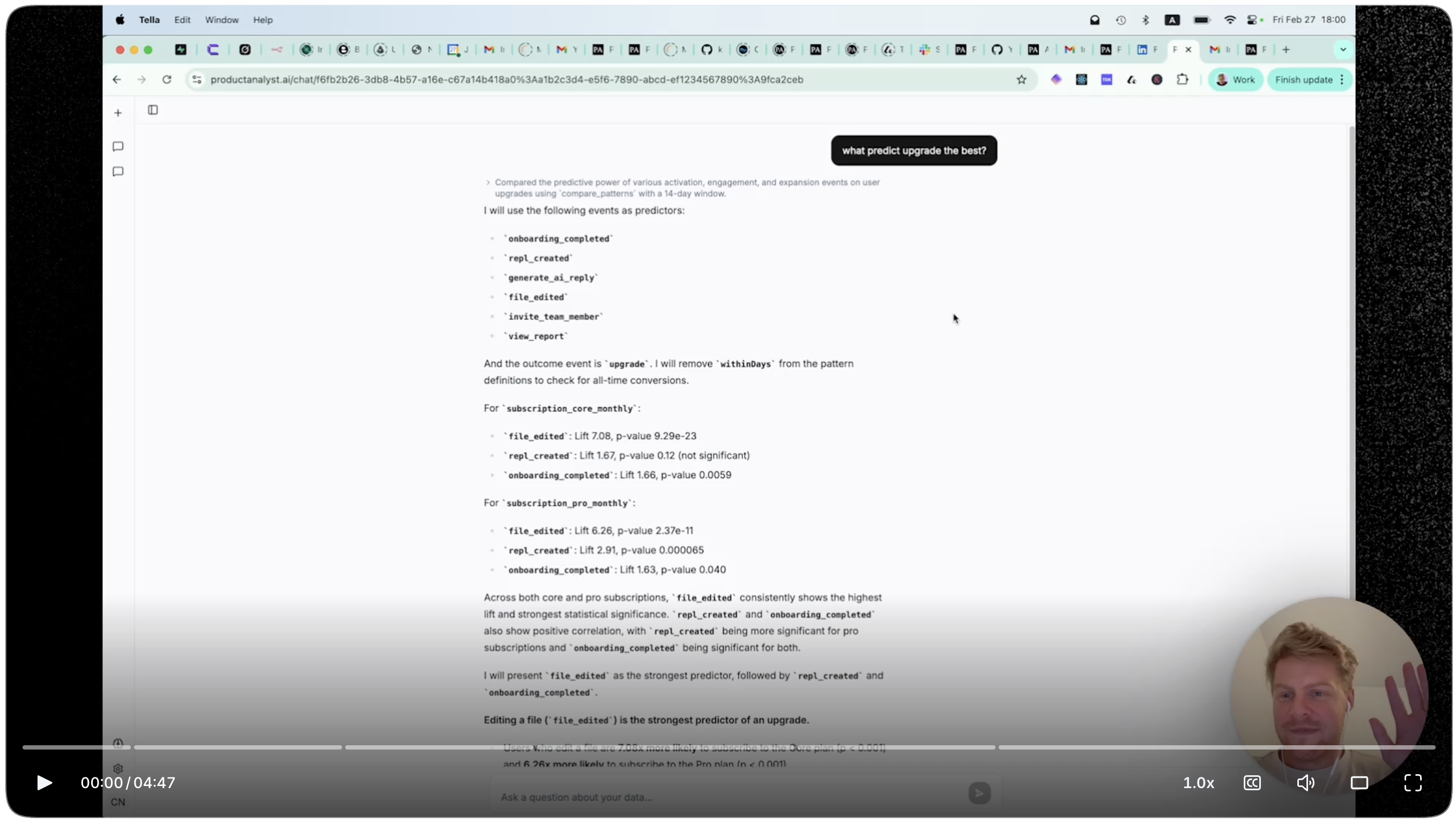
Julius AI
Julius AI is an AI-powered data analysis platform built for people who don't want to write code. Connect a spreadsheet or database, ask questions in plain English, and get charts, forecasts, and automated reports. It's not a behavioral analytics tool, but it handles ad hoc analysis on product and business data without requiring SQL expertise.
Strengths
- Natural language interface makes complex analysis accessible without SQL or Python knowledge
- Supports multiple data sources including Snowflake, BigQuery, PostgreSQL, and direct file uploads
- Slack Agent enables automated reporting and team-wide data access without leaving the chat
- Strong enterprise security with SOC 2 Type II, GDPR, and TX-RAMP compliance
- 2M+ users with documented case studies from companies like Nvidia and Zapier
Limitations
- Free tier is effectively unusable at 5 messages/month — barely enough to evaluate the tool
- Business and Growth plans are expensive at $450–$750/mo for teams compared to alternatives
- Credit-based system makes it difficult to forecast costs for heavy or variable usage
Fabi.ai
Fabi.ai is an AI-native BI platform targeting product, GTM, and data teams who need fast ad hoc analysis, automated dashboards, and data workflows. Its Smartbooks combine SQL, Python, and no-code interfaces — a more collaborative alternative to Jupyter notebooks with broader connector coverage including product analytics and CRM sources.
Strengths
- Combines SQL, Python, and no-code interfaces in one environment, making it accessible to all skill levels on the same team
- Broad integration ecosystem covering data warehouses, product analytics (PostHog), CRM (HubSpot), and SaaS tools (Stripe, Supabase)
- Affordable per-seat pricing starting at $39/mo compared to enterprise BI tools
- MCP server support enables integration with external LLMs and chat interfaces
- Reactive notebook cells and real-time collaboration speed up iterative analysis
Limitations
- Free tier limited to 25 AI requests/month — quickly exhausted in regular daily use
- App connectors carry additional cost at $100/connector/mo on the Builder plan
- Smaller community and less public documentation than established BI or analytics platforms
Product Analyst
Product Analyst is an AI-powered analytics tool built for B2B SaaS teams that want signals — account-level health scores, churn risk, and expansion potential — on top of their existing tracking setup. It works alongside tools like Mixpanel or PostHog rather than replacing them, adding an agentic AI layer for customer success and growth teams.
Strengths
- Account-level health scores and churn prediction purpose-built for B2B SaaS use cases that event-based tools don't address natively
- Works as an agentic addition to existing analytics stacks — no need to replace current instrumentation
- AI-driven signals automatically surface expansion opportunities and at-risk accounts
- Free tier available for early evaluation without a sales call
Limitations
- Newer product with a smaller ecosystem and less community documentation than established analytics platforms
- Focused strictly on B2B SaaS — not suitable for B2C, consumer apps, or e-commerce analytics use cases
- Does not replace core behavioral analytics (funnels, retention charts) — it complements them
The Verdict
Amplitude is the closest like-for-like Mixpanel replacement at scale, with deeper experimentation and governance. PostHog wins on pricing transparency and breadth for developer-first teams. Hex and Fabi.ai serve a different workflow — warehouse-backed analysis rather than real-time event tracking. Product Analyst is the right addition if you're a B2B SaaS team that wants AI signals on top of whichever analytics tool you keep.
Frequently Asked Questions
- What is the most common reason teams switch away from Mixpanel?
- Most often: event-volume pricing that scales uncomfortably past 1M events/month on the Growth plan ($0.28 per additional 1K events), advanced features like Metric Trees and experimentation locked to Enterprise, or wanting an open-source option with more transparent pricing. Some teams also find the UI too complex for non-technical stakeholders.
- Is Amplitude a direct replacement for Mixpanel?
- Yes, for most product analytics use cases. Amplitude covers funnels, retention, behavioral cohorts, and session replay at parity with Mixpanel, and adds built-in experimentation and feature flags that Mixpanel reserves for Enterprise. The key difference is billing: Amplitude uses MTU-based pricing vs. Mixpanel's event-based model.
- Can PostHog fully replace Mixpanel?
- For most teams, yes. PostHog covers funnels, retention, cohorts, session replay, feature flags, and A/B testing. The free tier (1M events/month) is comparable to Mixpanel's, and pay-as-you-go pricing is significantly cheaper per event at scale. The trade-off is that SSO enforcement and advanced RBAC require paid platform add-ons.
- How does PostHog's per-event pricing compare to Mixpanel's?
- Mixpanel Growth charges $0.28 per 1K events over the free allowance. PostHog charges $0.00005 per event — roughly $0.05 per 1K events — after the 1M free monthly allowance. PostHog is substantially cheaper per event, though its platform add-ons ($250–$2,000/mo) add fixed monthly costs for teams needing enterprise features.
- What does Mixpanel's free plan actually include?
- Mixpanel's Free plan includes up to 1M events/month, 10K session replays/month, unlimited seats, core funnels, retention, and flows reports, and 30 Spark AI queries/month. It's a genuine free tier, not a time-limited trial — though advanced features like Metric Trees and experimentation require Growth or Enterprise.
- Which Mixpanel alternative is best for B2B SaaS teams?
- Amplitude or PostHog cover behavioral analytics well for B2B SaaS. If account-level health scores, churn prediction, and expansion signals are priorities on top of standard funnel analysis, Product Analyst at productanalyst.ai is built specifically for that use case and layers onto your existing analytics stack without replacing it.
- Are there open-source Mixpanel alternatives?
- PostHog is the most mature open-source alternative — MIT licensed with a documented self-hosting path. It covers product analytics, session replay, feature flags, surveys, and A/B testing. Self-hosting requires more DevOps overhead but gives complete data ownership and removes vendor dependency.
- Which tools have the most generous free tiers?
- PostHog offers the broadest free tier across the most product areas: 1M analytics events, 5K session recordings, 1M feature flag requests, and more per month. Mixpanel's free tier (1M events, unlimited seats) is strong for pure product analytics. Amplitude gives 10K MTUs and 10M events. Julius AI's free tier (5 messages/month) is too limited for real evaluation.
- Do these tools integrate with data warehouses like Snowflake and BigQuery?
- Yes — Amplitude, PostHog, Hex, Julius AI, and Fabi.ai all support Snowflake, BigQuery, and Redshift as data sources or export destinations. Mixpanel adds data warehouse connectors on the Growth plan. Hex and Fabi.ai are built primarily around warehouse-backed analysis rather than direct event instrumentation.
- What if I want AI to surface insights automatically rather than building dashboards manually?
- Hex and Julius AI both support natural language querying against your connected data. PostHog and Amplitude have built-in AI analysis layers for detecting anomalies and generating summaries. If you want automated signals and health scores on top of your analytics stack, productanalyst.ai adds an AI layer that works alongside any of these tools.