PostHog bundles analytics, session replay, feature flags, and A/B testing into one platform with usage-based pricing — but that breadth isn't always what teams need. Some want deeper behavioral analytics and a longer enterprise track record; others want AI-native analysis or account-level signals for B2B SaaS. Here are the strongest alternatives worth evaluating.
How we evaluated
Evaluated alternatives on: core analytics depth for product teams, pricing transparency and predictability, AI capabilities, integration with existing data stacks, and fit for specific team types — engineers, data analysts, product managers, and B2B growth teams. Ranked by relevance as a PostHog replacement, not by general tool quality.
Amplitude
Amplitude is the most direct PostHog competitor for mid-to-large teams. It combines product analytics, session replay, and experimentation in one platform, with a 14-year track record, mature enterprise controls, and AI capabilities built into the core product — not bolted on.
Strengths
- Deep behavioral analytics with advanced cohorts, predictive audiences, and causal insights that go beyond standard funnel analysis
- Full experimentation suite including multi-armed bandit and CUPED variance reduction at Enterprise tier
- Startup scholarship: one free year of Growth plan for companies under $10M funding
- 150+ integrations covering data warehouses, marketing platforms, and reverse ETL tools
- AI Feedback distills customer sentiment from feedback records; AI Visibility tracks LLM prompt analytics
Limitations
- MTU-based billing can surprise teams migrating from event-based PostHog pricing — model the numbers before switching
- Feature Experimentation and cross-product analytics locked to custom-priced Growth and Enterprise tiers
- Steeper learning curve than PostHog for engineering teams accustomed to a developer-first UI
Mixpanel
Mixpanel is a mature event-based analytics platform with a genuinely generous free tier, natural language querying via Spark AI, and strong retention and funnel analysis. It's the most natural swap if you want to stay in product analytics but move off PostHog.
Strengths
- 1M events/month free with unlimited seats — more accessible than most alternatives at early stage
- Spark AI query builder translates plain English into analytics queries against your actual event data
- Session replay tied directly to analytics events makes debugging user flows fast
- Startup program: first year free for companies founded within 5 years with under $8M funding
- Metric Trees connect raw event data to business KPIs and driver analysis
Limitations
- Growth plan overage pricing at $0.28 per 1K events can compound quickly at high volume — more expensive per event than PostHog's $0.00005/event
- Metric Trees, feature experimentation, and anomaly detection require the Enterprise plan
- Spark AI query limits apply on all plans, including Enterprise, so heavy users will hit ceilings
Hex
Hex is an AI-native analytics platform for data teams who have outgrown purpose-built product analytics dashboards. It combines SQL and Python notebooks, BI-style data apps, and a conversational self-serve layer — all backed by a shared semantic model. Not a PostHog replacement for event tracking, but a strong upgrade path for teams doing custom analysis.
Strengths
- Combines code notebooks, interactive data apps, and conversational AI in a single environment — analysts and stakeholders share the same context
- Threads agent handles plain-language questions from non-technical users via Slack without requiring SQL access
- Agentic notebook environment with SQL, Python, and visualization cells in one linear workflow
- Deep warehouse integrations (Snowflake, BigQuery, Databricks, ClickHouse) with OAuth database connections
- Free Community tier for individuals; 14-day trial on Team plan
Limitations
- Per-seat pricing at $36-$75/month per editor scales cost quickly for larger teams
- Not a drop-in replacement for PostHog — no event tracking SDK, no session replay, no feature flags
- SSO, audit logs, and HIPAA compliance locked behind Enterprise tier
Product Analyst
Still digging through dashboards?
Ask any product data question and get answers in seconds — no SQL, no waiting.
Try Product Analyst — Free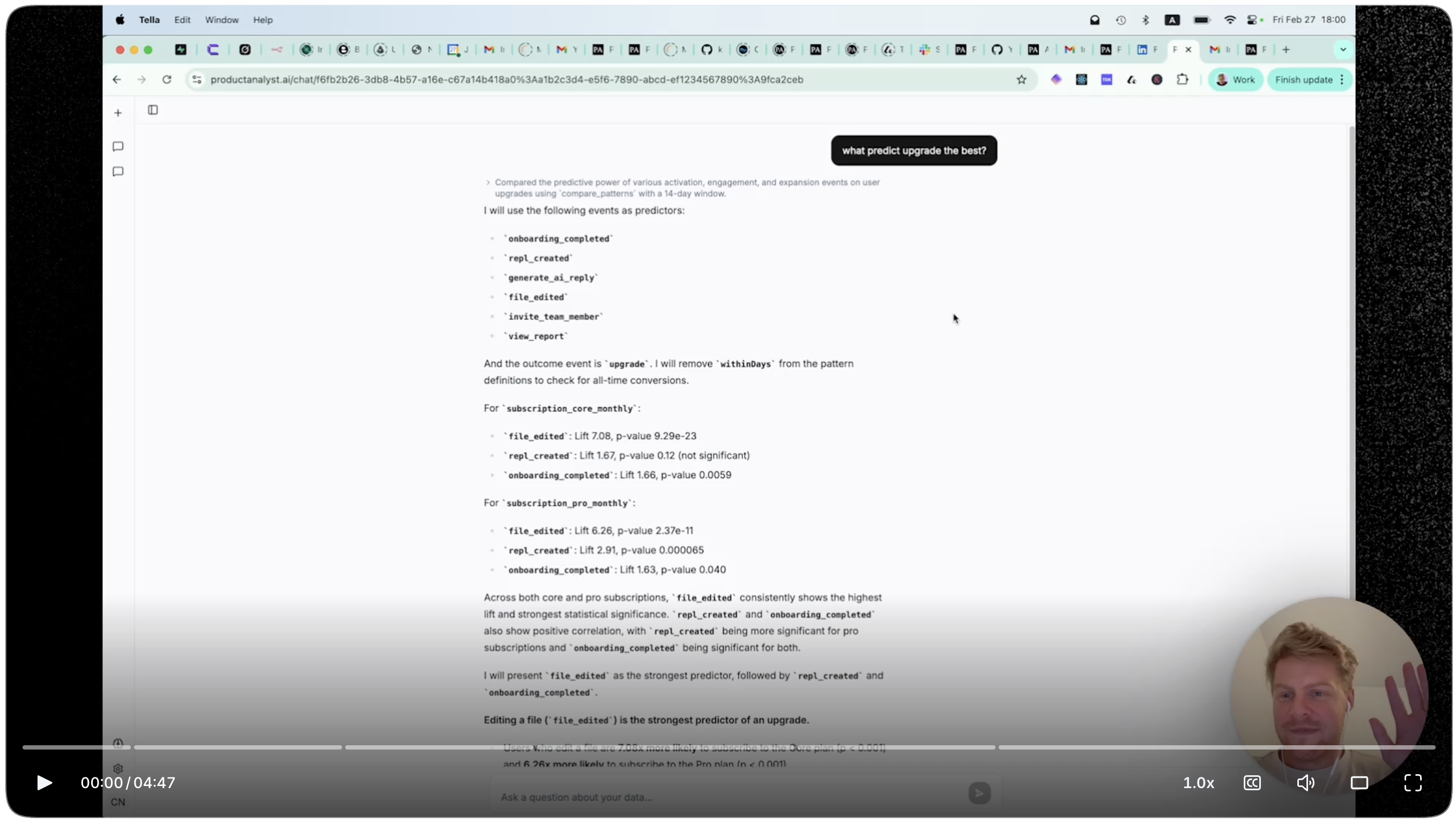
Fabi.ai
Fabi.ai is an AI-native BI platform built for product, GTM, and data teams who need fast ad hoc analysis across multiple data sources. Smartbooks combine SQL, Python, and no-code interfaces, and the AI Analyst Agent can answer questions across PostHog event data, Stripe revenue, and HubSpot CRM in a single workflow.
Strengths
- Native connectors for PostHog, Stripe, HubSpot, and all major data warehouses — cross-source analysis without writing ETL
- AI Analyst Agent handles natural language queries across product analytics, revenue, and CRM data simultaneously
- MCP server support lets you query your data from Claude, ChatGPT, and other external LLM interfaces
- Affordable per-seat pricing: Builder at $39/seat, Team at $50/seat with unlimited AI requests
- Scheduled reports and reverse data syncs reduce manual reporting workload
Limitations
- Free tier caps at 25 AI requests/month and 5 Smartbooks — not enough for daily analytical use
- App connectors (PostHog, Stripe, HubSpot) cost an additional $100/connector/month on the Builder plan
- Newer platform with a smaller community and less third-party documentation than established BI tools
Product Analyst
Product Analyst is an AI-powered product intelligence tool for B2B SaaS teams. It layers on top of your existing analytics stack — PostHog, Amplitude, or Mixpanel — and delivers account-level health scores, churn risk signals, and expansion potential. It doesn't replace event tracking; it turns event data into customer-level signals.
Strengths
- Account-level health scores aggregate raw user behavior into a single signal per customer — useful for CS and product teams monitoring a large account base
- Churn risk and expansion signals designed specifically for B2B SaaS metrics, not generic event counts
- Works alongside PostHog or any other analytics tool — no rip-and-replace migration required
- AI-generated signals reduce the manual analysis time needed to monitor customer health across hundreds of accounts
- Free tier available for teams evaluating without a sales commitment
Limitations
- Newer product with a smaller public track record than established analytics platforms
- Focused on B2B SaaS — less relevant for consumer apps, e-commerce, or developer tools with no account structure
- Not a direct PostHog replacement — no event tracking SDK, session replay, feature flags, or funnel analysis
Julius AI
Julius AI is a conversational data analysis platform trusted by over 2 million users. Connect spreadsheets or databases, ask questions in plain English, and get charts and analysis in seconds. It's the furthest departure from PostHog on this list — no event tracking, no product analytics — but useful if your PostHog use case is primarily ad hoc data exploration.
Strengths
- Natural language interface requires no SQL, Python, or R knowledge — non-technical users can analyze data independently
- Supports Python, R, and SQL for users who need to go beyond conversational queries
- Strong enterprise security: SOC 2 Type II, GDPR, and TX-RAMP compliance
- Slack integration and scheduled report delivery reduce reliance on a central data team for routine questions
- 2M+ users with enterprise case studies from Nvidia and Zapier
Limitations
- Free tier is functionally unusable at 5 messages/month — any real evaluation requires a paid plan
- Business and Growth plans ($450-$750/month) are expensive relative to the scope of what they offer
- Credit-based pricing is opaque for heavy users trying to forecast monthly costs
The Verdict
For most teams switching from PostHog, Amplitude or Mixpanel are the safest direct replacements — both are mature product analytics platforms with strong free tiers and well-documented migration paths. If your team works primarily in a data warehouse and needs custom analysis, Hex or Fabi.ai are worth evaluating. For B2B SaaS teams focused on account health and churn signals, Product Analyst adds AI intelligence on top of whichever tracking tool you keep.
Frequently Asked Questions
- What is the closest alternative to PostHog for product analytics?
- Amplitude and Mixpanel are the most direct competitors. Both cover event-based analytics, session replay, and experimentation. Amplitude is stronger on enterprise features, causal insights, and AI-powered analysis. Mixpanel has a more generous free tier (1M events/month, unlimited seats) and simpler per-event pricing at scale. Your choice depends on team size, budget, and whether you need advanced experimentation.
- Is PostHog actually free?
- Yes — PostHog's free tier includes 1M analytics events, 5K session recordings, and 1M feature flag requests per month with no seat limits. PostHog says over 90% of their customers never pay anything. Paid add-ons (Boost, Scale, Enterprise) start at $250/month and are primarily for RBAC, SSO enforcement, and dedicated support.
- Can I self-host any PostHog alternatives?
- PostHog is the only major product analytics tool with a full open-source, self-hosted deployment. None of the alternatives on this list — Amplitude, Mixpanel, Hex, Fabi.ai, Julius, or Product Analyst — offer self-hosting. If data sovereignty is your reason for leaving PostHog, PostHog's self-hosted version may actually resolve the issue.
- How does Mixpanel pricing compare to PostHog?
- Both use event-based pricing. Mixpanel's free tier covers 1M events/month; PostHog's free tier matches that. At scale, Mixpanel charges $0.28 per 1K events over the free limit. PostHog charges $0.00005 per event — roughly $0.05 per 1K events — making PostHog significantly cheaper for high-volume applications sending tens of millions of events.
- What's the best free PostHog alternative?
- Mixpanel's free tier is the most generous for product analytics: 1M events/month, unlimited seats, and 10K session replays. Amplitude's free tier covers 10K MTUs with up to 10M events and includes session replay and basic feature flags. Hex has a free Community tier for individual analysts. Fabi.ai's Starter plan is free with 25 AI requests/month, though that limits practical daily use.
- Is Amplitude worth switching to from PostHog?
- Depends on what you're missing. Amplitude has a 14-year track record, more mature enterprise controls (SCIM, advanced permissions, data governance), and stronger causal analytics. PostHog is typically cheaper at scale and includes feature flags and A/B testing natively. If you need multi-armed bandit experiments, CUPED, or predictive audiences, Amplitude justifies the cost and migration effort.
- What's the difference between PostHog and a tool like Hex or Fabi.ai?
- PostHog is a purpose-built product analytics platform with event tracking SDKs that instrument your product. Hex and Fabi.ai are AI-powered analytics environments that sit on top of data you've already collected in a warehouse — they don't track events themselves. They're better suited for custom cross-source analysis than for out-of-the-box funnel, retention, and session replay tracking.
- Which PostHog alternative is best for B2B SaaS?
- For event-level product analytics, Amplitude and Mixpanel both handle B2B use cases well, including group analytics and account-level segmentation. For account-level signals — health scores, churn risk, expansion potential — Product Analyst is purpose-built for B2B SaaS and sits on top of your existing analytics stack rather than replacing it.
- What should I evaluate before switching from PostHog?
- Key questions: (1) Which PostHog features do you actually use — analytics, session replay, feature flags, A/B testing, or surveys? Not every alternative covers all of these. (2) How does the pricing model change at your current event volume? (3) Do you need event tracking SDKs or can you work from warehouse data? (4) What's your team's technical level — engineers, analysts, or product managers? Answers to these narrow the field quickly.
- Can I run multiple analytics tools at the same time?
- Yes, and it's common. Many teams use Amplitude or Mixpanel for core product analytics while adding separate tools for session replay, experimentation, or account intelligence. Migration doesn't have to be all-or-nothing — you can run tools in parallel during evaluation. If you want automated signals and health scores on top of your analytics stack, productanalyst.ai adds an AI layer that works alongside any of these tools.