Most teams have analytics instrumented but still can't answer 'why did retention drop last week?' — not because they lack data, but because they're using the wrong tool for their use case. This list covers the best product analytics tools across product-led, B2B SaaS, and enterprise contexts so you can match the tool to your actual workflow.
How we evaluated
Tools ranked by core product analytics capabilities (funnels, retention, cohorts, behavioral analysis), feature breadth, pricing accessibility for smaller teams, and real-world fit for product and growth teams. Narrow-focus or enterprise-only tools ranked lower regardless of technical quality.
Amplitude
Amplitude is the most complete product analytics platform on this list — funnels, retention, behavioral cohorts, session replay, feature flags, and A/B experimentation in one interface. Founded in 2012, it's widely deployed at mid-to-large product teams and has layered AI-powered analysis across most features.
Strengths
- Comprehensive suite combining product analytics, session replay, experiments, and feature flags without multiple tool subscriptions
- Strong AI capabilities: AI Feedback for sentiment analysis, AI Visibility for LLM prompt analytics, and MCP support for agent integration
- Generous free tier — 10K MTUs and up to 10M events including session replay and feature flags
- Startup scholarship offers one free year of the Growth plan for early-stage companies under $10M funding
- 150+ integrations spanning data warehouses, CDPs, ad platforms, and CRM tools
Limitations
- MTU-based billing becomes complex at scale and can result in unexpected costs as user counts grow
- Feature experimentation, causal insights, and cross-product analysis require custom-priced Growth or Enterprise plans
- Steeper learning curve than simpler tools due to the breadth of the platform
PostHog
PostHog covers more product tooling than any other platform here — analytics, session replay, feature flags, A/B testing, surveys, error tracking, and a managed data warehouse, all usage-based. Open-source, self-hostable, and over 90% of users run it entirely on the free tier.
Strengths
- Free tier includes 1M analytics events, 5K session recordings, 1M feature flag requests, error tracking, and surveys across 10+ products
- Transparent usage-based pricing with per-product spend caps to prevent surprise bills
- Open-source (MIT licensed) with self-hosting option for teams that need full data control
- Can replace Amplitude, LaunchDarkly, Sentry, and a managed data warehouse under one bill
- Developer-friendly: CLI install wizard, MCP support, extensive API, and technically capable support staff
Limitations
- Usage-based pricing is hard to forecast for high-volume applications with spiky traffic
- RBAC, SSO enforcement, and audit logs require paid platform add-ons at $250–$2,000/mo
- Founded in 2020 — less enterprise track record compared to Amplitude or Mixpanel
Mixpanel
Mixpanel has been the default event-based product analytics tool since 2009. It excels at behavioral analysis — funnels, retention, cohorts, flows — and has added AI-powered querying (Spark), session replay, and experimentation in recent years. Free tier offers 1M events/month with unlimited seats.
Strengths
- 1M events/month free with unlimited seats — one of the most accessible free tiers in product analytics
- Spark AI query builder translates natural language questions into analytics reports
- Deep event-based analysis: best-in-class funnels, cohorts, retention, and user flows
- Session replay tied directly to analytics data for fast debugging without context switching
- Data warehouse connectors (Snowflake, BigQuery, Redshift) included without additional cost
Limitations
- Growth plan overage pricing at $0.28 per 1K events adds up quickly for high-volume apps above 1M events/month
- Metric Trees and feature experimentation are locked behind the Enterprise plan
- Spark AI query builder has monthly query limits on all plans (30–300 queries depending on tier)
Product Analyst
Still digging through dashboards?
Ask any product data question and get answers in seconds — no SQL, no waiting.
Try Product Analyst — Free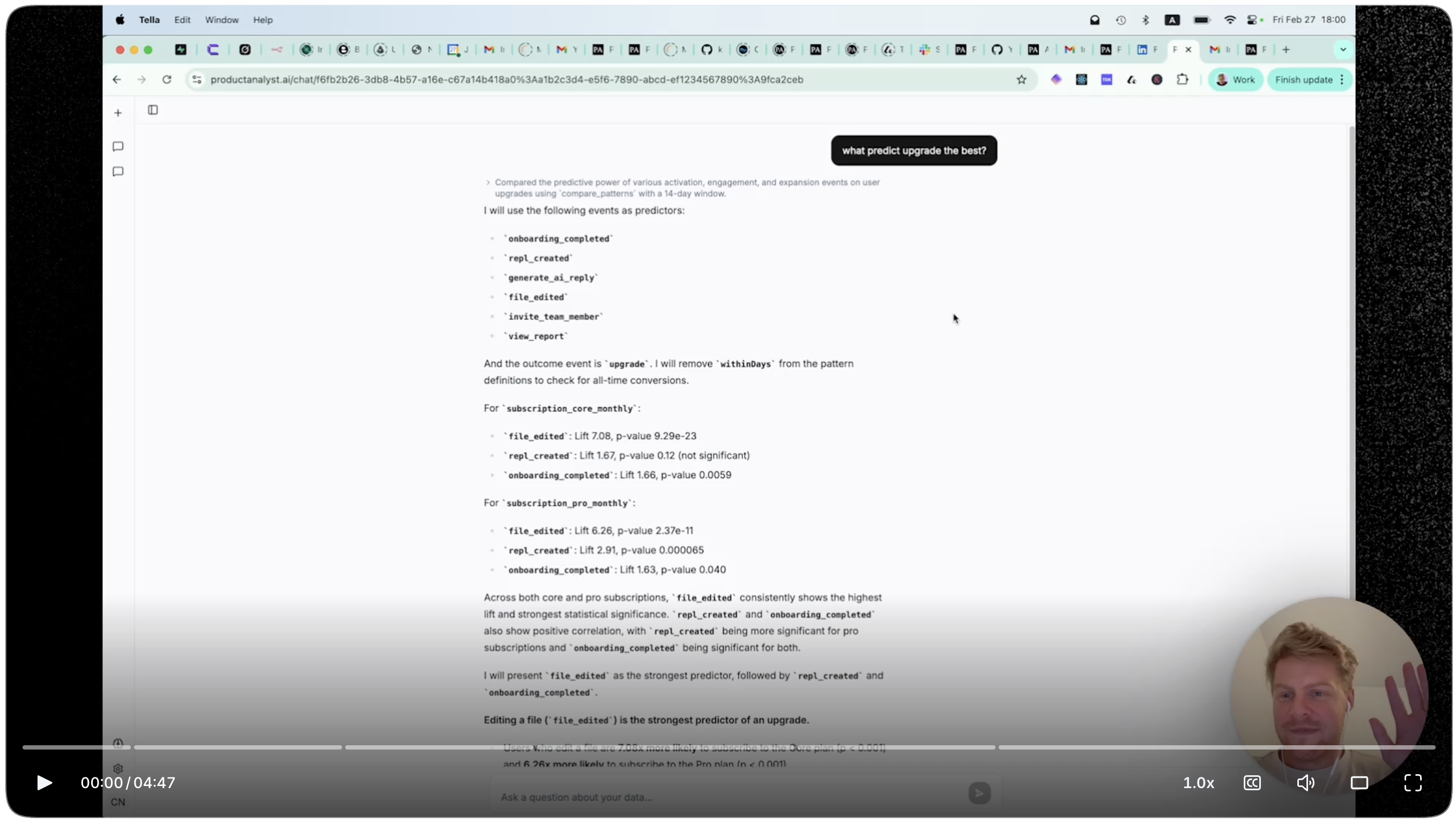
Google Analytics 4
GA4 is free, cross-platform, and tightly wired into Google's advertising and marketing stack. It uses an event-based model with built-in ML for predictive metrics and audience creation. Strong for web analytics and acquisition measurement; weaker for deep product behavioral analysis compared to dedicated tools.
Strengths
- Completely free for standard use with up to 10M events per day
- Deep integration with Google Ads, Search Console, and the broader Google marketing ecosystem
- Built-in ML surfaces predictive metrics: purchase probability, churn probability, and predicted revenue
- Cross-platform measurement — web, iOS, and Android tracked in a single property
- Free BigQuery export for raw event-level data access and advanced custom analysis
Limitations
- Data sampling in Explorations on the free tier reduces accuracy for high-traffic sites
- 14-month data retention limit on the free tier restricts long-term cohort and lifecycle analysis
- Less suited for deep behavioral product analytics — cohorts, retention curves, and funnel debugging are weaker than dedicated tools
Hex
Hex is an AI analytics platform for data teams — agentic notebooks (SQL + Python), conversational self-serve analytics via Threads, and shareable data apps in one system. It's not a product analytics tool in the Amplitude/Mixpanel sense; it's a modern analytical workspace built for teams that need both depth and stakeholder accessibility.
Strengths
- Combines agentic notebooks, BI dashboards, and conversational self-serve analytics in a single platform
- Threads agent lets business users ask plain-language questions against a curated semantic model with accurate results
- MCP server support enables integration with Claude and Cursor for AI-assisted analysis
- Deep warehouse integrations (Snowflake, BigQuery, Databricks) with OAuth support
- Trusted by data-intensive companies including Anthropic, Figma, Reddit, and Ramp
Limitations
- Per-seat pricing ($36–$75/seat/mo) gets expensive for larger analyst teams
- SSO and audit logs locked to Enterprise tier — not available on Team plan
- Credit-based AI usage may throttle heavy notebook users on lower tiers
Product Analyst
ProductAnalyst.ai is an AI-powered layer for B2B SaaS product teams that surfaces account-level health scores, churn risk signals, and expansion potential from existing product and CRM data. It works as an agentic addition to your current tracking stack — not a replacement for Amplitude or Mixpanel.
Strengths
- Purpose-built for B2B SaaS with account-level health scores and churn risk signals that general analytics tools don't surface
- Works alongside existing analytics stacks (Amplitude, Mixpanel, PostHog) — no rip-and-replace required
- Surfaces expansion and upsell opportunities automatically from behavioral signals
- Free tier available with paid plans starting at $49/mo
Limitations
- Newer product with a smaller track record than established analytics platforms
- Narrowly focused on B2B SaaS — not useful for consumer apps, e-commerce, or general web analytics
- Requires good upstream data quality from existing tracking to produce accurate signals
Julius AI
Julius AI is a conversational data analysis tool — connect spreadsheets, databases, or cloud storage and ask questions in plain English. It targets non-technical analysts who need to explore data without SQL or Python, though it supports both for advanced users. Over 2M users have used it.
Strengths
- Natural language interface with no coding required — accessible to non-technical analysts
- Supports Python, R, and SQL for users who need to go beyond conversational queries
- Strong enterprise security: SOC 2 Type II, GDPR, and TX-RAMP certified
- Slack Agent enables team-wide data queries without opening a dashboard
- 2M+ user base with documented case studies from Nvidia and Zapier
Limitations
- Free tier capped at 5 messages/month — too limited for any meaningful evaluation
- Business and Growth plans are expensive at $450–$750/mo for team access
- Credit-based pricing lacks transparency for teams with variable analysis volume
Fabi.ai
Fabi.ai is an AI-native BI tool built around Smartbooks — notebooks that combine SQL, Python, and no-code blocks for ad hoc analysis, dashboards, and automated workflows. It targets product and GTM teams at startups who need fast answers from multiple data sources without standing up a full data stack.
Strengths
- Combines SQL, Python, and no-code in one reactive notebook interface for all skill levels
- Broad connector ecosystem including PostHog, Stripe, HubSpot, Supabase, and major data warehouses
- MCP server support for LLM and external chat integration
- Affordable per-seat pricing at $39–$50/seat/mo for small teams
- Scheduled reports and reverse data syncs for automated workflow delivery
Limitations
- Free tier limited to 25 AI requests/month and 5 Smartbooks — restrictive for evaluation
- App connectors cost $100/connector/mo on the Builder plan, adding up quickly for multi-source setups
- Smaller community and ecosystem than established BI tools
Loops
Loops uses proprietary causal inference models to automatically identify why KPIs change — root cause analysis, release impact measurement, and hidden segment discovery without A/B tests. It's a specialist tool layered on your data warehouse, not a general product analytics platform.
Strengths
- Causal inference approach explains why metrics changed, not just that they did
- Measures feature release impact without A/B testing — useful when controlled experiments aren't feasible
- Automated KPI monitoring and alerting with no-code setup
- Proven ROI case studies from Monday.com, ClickUp, AB InBev, and Postman
Limitations
- No public pricing — enterprise/demo-only model excludes smaller teams from self-serve evaluation
- Narrowly focused on KPI causal analysis, not a general-purpose product analytics replacement
- Limited public documentation on supported integrations and data source requirements
The Verdict
Amplitude is the most complete single platform for product analytics, experimentation, and session replay. PostHog matches it on features while undercutting on price — most teams use it entirely free. Mixpanel remains the strongest standalone event analytics option. For B2B SaaS teams that need account health scores and churn signals, productanalyst.ai works as an AI layer on top of any of these tools.
Frequently Asked Questions
- What is product analytics software?
- Product analytics software tracks how users interact with a product — which features they use, where they drop off, how often they return — and turns that event data into insights like funnels, cohorts, and retention curves. It's distinct from web analytics because it focuses on user behavior inside the product, not just the marketing site or acquisition funnel.
- What's the difference between product analytics and web analytics?
- Web analytics (like GA4) measures traffic acquisition, pageviews, and sessions — optimized for marketing and content sites. Product analytics tools (like Amplitude or Mixpanel) track granular user behavior inside the product: feature usage, funnel completion, retention by cohort, and account-level activity. Most product teams need both, wired to different use cases.
- Which product analytics tool has the best free tier?
- PostHog offers the most generous free tier — 1M analytics events, 5K session recordings, 1M feature flag requests, error tracking, and surveys all free with no credit card required. Mixpanel is close behind with 1M events/month and unlimited seats. Amplitude's free tier covers 10K MTUs and up to 10M events, which suits smaller or early-stage products.
- How much does product analytics software typically cost?
- Costs vary significantly by volume and features. PostHog and Mixpanel both offer usable free tiers up to 1M events/month. Amplitude's Plus plan starts at $49/mo (billed annually). Hex seats start at $36/mo. Fabi.ai Builder seats are $39/mo. Enterprise plans for Amplitude, Mixpanel, and Loops are custom-priced and require a sales conversation.
- Amplitude vs Mixpanel vs PostHog — which should I pick?
- Pick Amplitude if you want the most feature-complete platform and can grow into its pricing. Pick Mixpanel if you need best-in-class event analytics without the full platform overhead and want unlimited seats on the free tier. Pick PostHog if you're a developer-first team that wants analytics, feature flags, error tracking, and session replay in one open-source platform.
- Do I need a product analytics tool if I already have Google Analytics?
- GA4 is primarily built for marketing and web traffic measurement, not behavioral product analytics. If you need funnels by feature, retention curves by cohort, or account-level analysis, a dedicated tool like Amplitude, Mixpanel, or PostHog will give you far more value. Many teams run both: GA4 for acquisition and SEO, a product analytics tool for engagement and retention.
- What is event-based analytics and why does it matter?
- Event-based analytics tracks discrete user actions — 'user clicked button', 'user completed onboarding', 'user exported report' — instead of pageviews or sessions. Each event carries properties (user ID, plan, device) that enable segmentation and cohort analysis. Amplitude, Mixpanel, and PostHog all use event-based models. GA4 also moved to events in 2020.
- Can I use multiple product analytics tools at the same time?
- Yes, and many teams do. A common setup: Amplitude or Mixpanel for deep product analytics, GA4 for SEO and paid acquisition, and PostHog for feature flags and A/B testing. The risk is event schema drift between tools and analyst time spent reconciling different numbers. A CDP like Segment can route events to multiple destinations from a single source of truth.
- What should I look for when evaluating product analytics tools?
- Key criteria: event volume limits and overage pricing, whether session replay is included or a separate cost, funnel and retention analysis quality, how easily you can define behavioral cohorts, data export options (BigQuery, Snowflake), and whether the tool matches your team's technical level. For B2B SaaS, account-level analytics and group tracking matter more than they do for consumer apps.
- Are there AI-native product analytics tools worth considering?
- Most established tools have added AI — Amplitude has AI-powered insights and session summaries, Mixpanel has the Spark query builder, PostHog has natural language queries. Truly AI-native platforms like Hex and Loops are built around AI from the ground up for specific analytical workflows. If you want automated signals and health scores on top of your analytics stack, productanalyst.ai adds an AI layer that works alongside any of these tools.