PostHog and Amplitude both cover the product analytics core — funnels, retention, cohorts — but they diverge sharply on pricing philosophy, openness, and breadth. PostHog bundles everything into one usage-based platform with a self-hosting option; Amplitude is a mature SaaS product built for teams that want depth over DIY.
PostHog
Open-source product analytics platform for engineers — analytics, session replay, feature flags, A/B testing, and more in one usage-based product.
PostHog is an open-source, all-in-one analytics platform built primarily for product engineers. It bundles product analytics, session replay, feature flags, A/B testing, surveys, error tracking, and a managed data warehouse under transparent, usage-based pricing — with a genuine self-hosting option.
Amplitude
Established digital analytics platform combining product analytics, experimentation, session replay, and AI-powered insights for mid-to-large teams.
Amplitude is a mature digital analytics platform that has been building out behavioral analytics, experimentation, and AI capabilities since 2012. It targets product and growth teams at scaling companies that need deep behavioral analysis, structured governance, and a polished multi-user workspace.
Feature Comparison
| Category | PostHog | Amplitude | Edge |
|---|---|---|---|
| Analytics Depth | Funnels, trends, retention, paths, lifecycle, group analytics, SQL editor for ad-hoc queries. Solid breadth across core product analytics primitives. | Funnels, retention, paths, behavioral cohorts, predictive audiences, causal insights, conversion drivers, cart analysis. Deeper behavioral modeling out of the box. | Amplitude |
| Pricing & Value | Usage-based after a generous free tier (1M events, 5K replays, 1M feature flag requests/mo). Over 90% of users stay entirely on the free tier. | MTU-based freemium. Free up to 10K MTUs / 10M events. Paid plans from $49/mo. Advanced features locked behind custom-priced Growth and Enterprise tiers. | PostHog |
| Ease of Use | Engineer-oriented UI. Clean but assumes technical comfort. CLI install wizard, MCP support, and a technical-first documentation style. | Polished product UI with prebuilt templates, saved charts, and a visual web experimentation editor. Lower barrier for non-technical product managers. | Amplitude |
| Integrations | 120+ sources and destinations via managed data warehouse. Snowflake, BigQuery, Redshift, Stripe, Segment, Supabase, Sentry, Hubspot, Salesforce. | 150+ integrations including ad platforms (Google Ads, Facebook Ads, TikTok Ads), mobile attribution (AppsFlyer, Adjust, Branch), CRM, CDPs, and data warehouses. | Amplitude |
| Support & Documentation | Email support on pay-as-you-go; Slack-based support above $2K/mo. Technically deep docs and an active open-source community on GitHub. | Community and academy on Starter. Online support on Plus. 2-business-day SLA on Growth; assigned account manager and 1-business-day SLA on Enterprise. | Tie |
| Scalability | Scales via usage-based pricing with no hard caps. Self-hosting available for teams needing full data sovereignty at any scale. | Built for large organizations: cross-product analysis, mutual exclusion groups, CUPED variance reduction, and enterprise governance controls. | Tie |
| AI Features | PostHog AI for natural language queries, AI-assisted experiment creation, LLM Analytics (evals, traces, generations), MCP support for AI agent integration. | AI Feedback for customer sentiment, AI Visibility for LLM prompt analytics, AI-generated session replay summaries, AI Data Assistant for governance, MCP support. | Tie |
| Open Source | MIT licensed. Full source on GitHub. Self-hosting is a first-class, documented, supported deployment path with no feature degradation. | Closed-source SaaS. No self-hosting option available. | PostHog |
Analytics Capabilities
Both tools cover the essential product analytics primitives — funnels, retention, cohorts, and user paths. The gap opens when you need advanced behavioral modeling: causal inference, predictive segmentation, and statistical rigor that Amplitude has built over 14 years.
PostHog
PostHog covers funnels, trends, retention, paths, lifecycle, and group analytics. A SQL editor lets analysts write raw queries, and a managed data warehouse can sync data from 120+ external sources. It's a complete suite for most product analytics use cases, without the depth of behavioral modeling Amplitude offers.
Amplitude
Amplitude adds causal insights, predictive audiences, conversion drivers, and cart analysis on top of the standard analytics suite. These features help teams understand not just what happened but why — particularly useful for growth and ecommerce teams. Behavioral cohorts and forecasting ship on lower tiers than PostHog's equivalents.
Pricing & Plans
PostHog and Amplitude take fundamentally different pricing approaches �� usage-based vs. MTU-based freemium. Which works better depends almost entirely on your event volume, user base size, and which advanced features you actually need.
PostHog
PostHog's free tier covers 1M analytics events, 5K session recordings, and 1M feature flag requests per month — enough that over 90% of companies use it completely free. Beyond that, pay-as-you-go: $0.00005/event for analytics, $0.005/recording for session replay. Platform add-ons for RBAC and SSO enforcement start at $250/mo.
Amplitude
Amplitude's Starter plan is free for up to 10K MTUs and 10M events. Plus costs $49/mo (billed annually) and covers up to 300K MTUs. Growth and Enterprise are custom-priced annually. Critical features — Feature Experimentation, SSO, predictive audiences, causal insights — require Growth or above, with no published price.
Product Analyst
Still digging through dashboards?
Ask any product data question and get answers in seconds — no SQL, no waiting.
Try Product Analyst — Free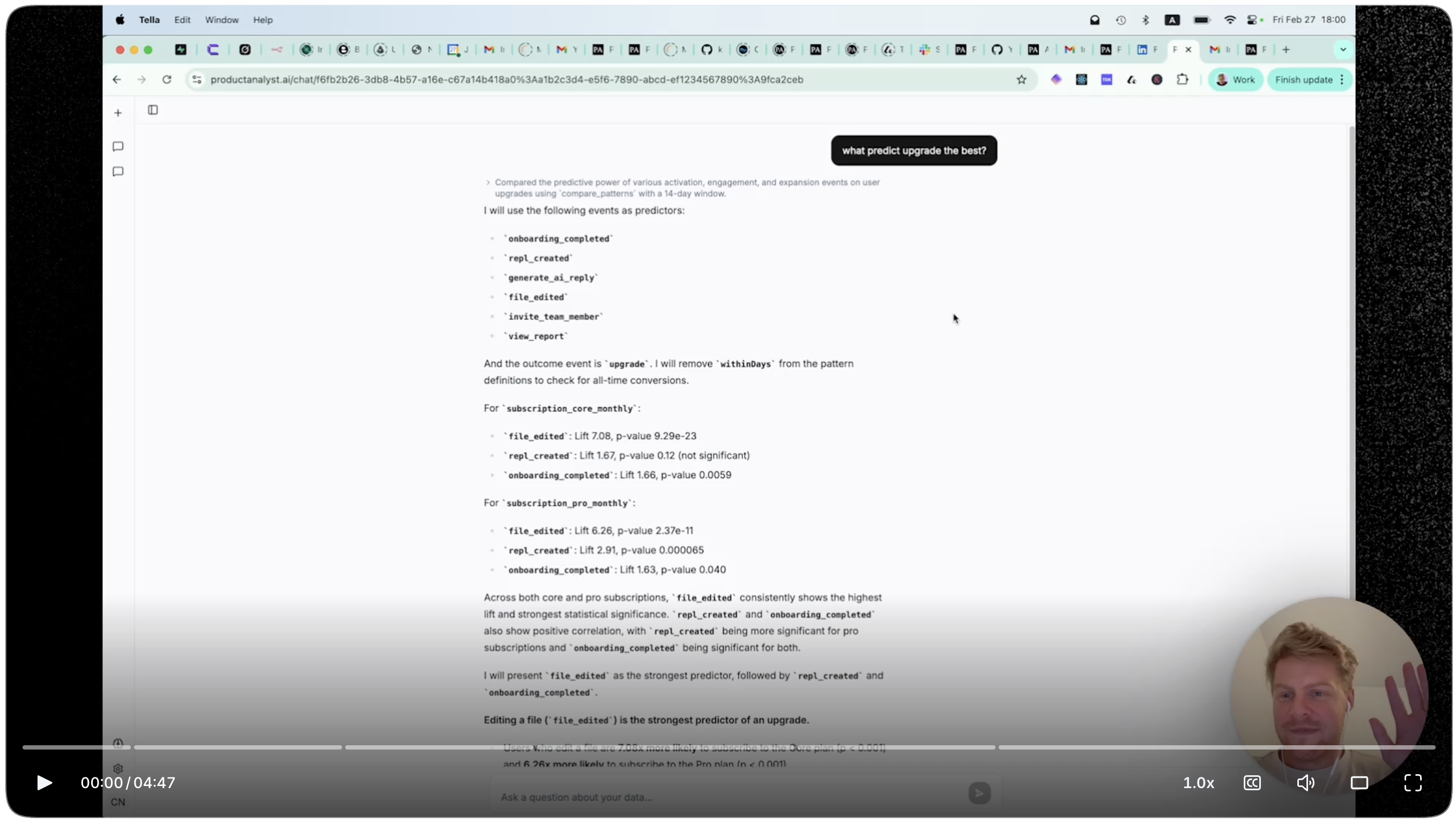
Developer Experience & Setup
PostHog was built by and for engineers. Amplitude has improved its developer tooling substantially, but its primary audience remains product managers and analysts who want structured dashboards over raw data access.
PostHog
PostHog offers a CLI install wizard (`npx @posthog/wizard`), MCP support for AI agent integration, extensive API and webhooks, and a technical support team. Self-hosting via Docker is a documented, maintained path. The open-source codebase means you can inspect exactly how data is processed.
Amplitude
Amplitude provides SDKs for all major platforms including Unity and Unreal for game developers. Google Tag Manager integration and Autocapture reduce instrumentation overhead for non-engineering teams. The visual web experimentation editor lets PMs create experiments without writing code.
Experimentation & Feature Flags
Both platforms offer A/B testing and feature flags, but the statistical maturity and tier availability differ significantly. PostHog includes experimentation free; Amplitude's most rigorous statistical framework is behind its custom-priced tiers.
PostHog
PostHog includes feature flags and A/B testing on all tiers, including free. Multi-variate experiments are supported, and AI can help create experiments via natural language. Feature flag requests are metered at $0.0001/request after the 1M free-tier limit — predictable costs for high-flag-volume apps.
Amplitude
Amplitude's Starter plan includes unlimited feature flags and basic web experimentation. Full Feature Experimentation — A/B/n testing, sticky bucketing, mutual exclusion groups, multi-armed bandits, and CUPED variance reduction — requires Growth or Enterprise. At scale, this statistical framework is meaningfully more rigorous.
Session Replay & Behavioral Insights
Both include session replay in their free tiers. The practical differences are in volume limits, retention length, and what's layered on top of raw replays — particularly Amplitude's AI-generated summaries.
PostHog
PostHog includes 5K session recordings/month free and charges $0.005/recording beyond that. Replay covers web and mobile. Heatmaps are included. All replay data lives in the same platform, making it easy to move from a funnel drop-off directly to the sessions behind it.
Amplitude
Amplitude's Starter plan covers 1,000 sessions/month; Plus gets 10,000; Growth and Enterprise offer custom volumes with 3–12 month retention. AI-powered session summaries and tight integration with behavioral cohorts and experimentation provide richer context around replays.
Data Governance & Enterprise Readiness
Enterprise teams care as much about how data is managed as what can be queried. Amplitude has the longer track record in structured governance; PostHog addresses this via paid add-ons and the self-hosting option for teams with strict data residency requirements.
PostHog
PostHog supports RBAC, SSO enforcement, and advanced permissions via paid platform add-ons ($250–$2,000/mo). The open-source codebase and self-hosting option give security-conscious teams full data sovereignty — something no SaaS-only competitor can match. Data stays entirely in your infrastructure.
Amplitude
Amplitude includes SSO and project-level permissions on Growth, with full SCIM provisioning, Data Access Controls, and protected schemas on Enterprise. The AI Data Assistant helps teams maintain data governance without manual auditing. This tier of tooling is mature, documented, and battle-tested at large organizations.
Ecosystem & Integrations
Both platforms connect to the major data warehouses and CDPs. The divergence is in marketing channel coverage — a significant factor for growth teams running paid acquisition programs.
PostHog
PostHog integrates with Snowflake, BigQuery, Redshift, S3, Supabase, Segment, Rudderstack, Sentry, Hubspot, Salesforce, Intercom, and more via its data warehouse (120+ connectors). Strong for product and engineering workflows; lighter on paid media and mobile attribution integrations.
Amplitude
Amplitude covers the same data infrastructure layer and adds native integrations with Google Ads, Facebook Ads, TikTok Ads, AppsFlyer, Adjust, and Branch. For teams with meaningful paid acquisition budgets, the ability to close the loop between ad spend and product behavior in one platform is genuinely useful.
Pricing Comparison
PostHog is almost always cheaper at startup and growth scale. Amplitude's value proposition only justifies its cost if you need Growth-tier governance and statistical experimentation.
PostHog
Free: 1M events, 5K session recordings, 1M feature flag requests/mo. Pay-as-you-go: $0.00005/event, $0.005/recording, $0.0001/flag request. Platform add-ons: Boost $250/mo, Scale $750/mo, Enterprise $2,000/mo for RBAC and SSO enforcement.
Amplitude
Starter: Free, 10K MTUs / 10M events. Plus: $49/mo (annual), up to 300K MTUs / 25M events. Growth: custom annual pricing — includes full experimentation, SSO, predictive audiences, causal insights. Enterprise: custom — adds SCIM, mutual exclusion groups, CUPED, dedicated account manager.
The Verdict
PostHog wins on value and developer experience; Amplitude wins on analytics depth and enterprise governance. The right choice depends on your team's makeup and scale.
Choose PostHog if
Choose PostHog if you're a developer-first or early-stage team watching burn, want everything (analytics, session replay, feature flags, error tracking) under one transparent bill, or need self-hosting for compliance. The free tier alone handles most startups through Series A.
Choose Amplitude if
Choose Amplitude if your team is PM-heavy and needs polished dashboards non-engineers can build, you need causal insights and multi-armed bandit experiments, you run paid acquisition and want ad platform integrations, or you're at a scale where structured data governance and SCIM provisioning are non-negotiable.
Frequently Asked Questions
- Is PostHog's free tier genuinely useful, or is it bait-and-switch?
- PostHog claims over 90% of companies use it entirely on the free tier. The 1M event/month limit covers most early-stage products. You also get 5K session recordings, 1M feature flag requests, and A/B testing — all free. It's not a stripped-down trial; it's the full product with metered limits that most teams never hit.
- How does Amplitude's MTU pricing work in practice?
- MTU stands for Monthly Tracked User — any user whose event Amplitude receives that month counts, even if they only triggered one event. Starter caps at 10K MTUs. This model can be expensive for apps with large inactive user bases that still fire background events, or mobile apps where users churn slowly.
- Can PostHog actually replace Amplitude?
- For most product analytics use cases, yes. PostHog covers funnels, retention, cohorts, session replay, and feature flags. The gap is in advanced behavioral modeling: Amplitude's causal insights, predictive audiences, and multi-armed bandit experiments have no direct equivalent in PostHog today.
- Does PostHog's self-hosted option have feature parity with the cloud version?
- PostHog's documentation states that self-hosted deployments run the same codebase with no feature degradation. The tradeoff is operational overhead — you're responsible for scaling, backups, and upgrades. Most teams default to cloud unless they have strict data residency or compliance requirements.
- Which platform is better for mobile analytics?
- Both provide iOS, Android, React Native, and Flutter SDKs. Amplitude adds Unity and Unreal support for game developers and has deeper mobile attribution integrations (AppsFlyer, Adjust, Branch), which matter if paid mobile acquisition is a core channel. PostHog's mobile session replay is newer but functional.
- How do the experimentation features actually compare?
- PostHog includes feature flags and A/B testing free on all tiers. Amplitude's basic web experimentation is on Starter, but its statistical rigor — sticky bucketing, mutual exclusion groups, CUPED variance reduction, multi-armed bandits — requires Growth or Enterprise. For high-stakes experiments, Amplitude's framework is meaningfully more advanced.
- Which tool is easier to set up without a dedicated engineering team?
- Amplitude. Its visual web experimentation editor, Google Tag Manager integration, Autocapture, and polished dashboard UI make it accessible to non-technical users. PostHog's setup wizard helps, but it's built for engineers and assumes comfort with code-level instrumentation and SDK configuration.
- Does Amplitude offer any startup discounts?
- Yes — Amplitude runs a Startup Scholarship that provides one free year of the Growth plan for early-stage companies with under $10M in funding. PostHog's free tier is available without any application. If you qualify for Amplitude's scholarship and need Growth-tier features, it's worth applying before committing to a paid plan.
- Which handles AI and LLM product analytics better?
- Both have invested here. PostHog offers LLM Analytics purpose-built for teams shipping AI features — evals, traces, and generations. Amplitude's AI Visibility tracks and analyzes LLM prompts and adds AI-generated session summaries. If LLM observability is your primary need, PostHog's implementation is more purpose-built for it.
- Can I use either platform to understand customer health and predict churn?
- Both surface behavioral signals that inform customer health. Amplitude has predictive audiences that can flag churn risk based on behavior patterns. PostHog exposes raw event data via SQL and data warehouse exports for custom modeling. Tools like productanalyst.ai can complement either by adding AI-powered signals and health scores on top of your analytics data.