PostHog and Mixpanel both do event-based product analytics, but they're built for different kinds of teams. PostHog is an open-source, all-in-one platform aimed at engineers who want analytics, feature flags, session replay, and experiments under one roof. Mixpanel is a more focused analytics tool with a longer track record and a polished interface that appeals to product managers and marketers.
PostHog
Open-source product analytics with feature flags, session replay, A/B testing, and a managed data warehouse — all in one platform.
PostHog combines product analytics, session replay, feature flags, A/B testing, surveys, error tracking, and a managed data warehouse into a single open-source platform. It's built for engineer-led teams who want full data control, transparent usage-based pricing, and the option to self-host.
Mixpanel
Event-based product analytics with AI-powered querying, behavioral cohorts, and deep funnel analysis for product and marketing teams.
Mixpanel is a mature product analytics platform (founded 2009) focused on event tracking, funnel analysis, retention, and behavioral cohorts. Its Spark AI query builder and Metric Trees make it approachable for non-technical users, and its free tier supports unlimited seats.
Feature Comparison
| Category | PostHog | Mixpanel | Edge |
|---|---|---|---|
| Analytics Depth | Funnels, trends, retention, paths, lifecycle, group analytics, revenue analytics, and a SQL editor for custom queries beyond the UI | Funnels, retention, cohorts, flows, multi-touch attribution, Metric Trees, and anomaly detection — with strong behavioral segmentation throughout | Tie |
| Pricing & Value | Free tier covers 1M events plus session replay, feature flags, experiments, and error tracking simultaneously. Usage-based rates are transparent with per-product billing caps. | Free up to 1M events/month with unlimited seats. Growth plan overages at $0.28 per 1K events compound quickly — 10M events/month runs roughly $2,500/mo in overages alone. | PostHog |
| Ease of Use | Modern UI, but the breadth of 10+ products creates a learning curve. Engineers find it intuitive; non-technical users need more ramp-up time. | Purpose-built analytics UI refined over 17 years. Templates and Spark AI help non-technical users get answers without SQL or deep configuration. | Mixpanel |
| Integrations | 120+ sources and destinations via managed data warehouse. Native connectors to Stripe, Segment, Sentry, Salesforce, Hubspot, Snowflake, BigQuery, Redshift, and more. | Snowflake, BigQuery, Redshift, Segment, and reverse ETL tools. Solid warehouse connectivity but a narrower integration surface overall. | PostHog |
| Support & Documentation | Community support on free tier; Slack-based support for teams spending $2K+/mo. Strong docs maintained by an active open-source community. | Email support on all plans, 24/5 on Growth, 24/7 with dedicated account manager on Enterprise. Slack community available on free tier. | Tie |
| Scalability | Usage-based pricing scales linearly. Self-hosting available for data sovereignty. 7-year data retention on paid plans. Per-product billing caps prevent runaway costs. | Enterprise plan supports up to 1T events/month with customizable data retention. HIPAA compliance tools and compartmentalized data access available at Enterprise tier. | Mixpanel |
| AI Features | PostHog AI for natural language queries and automation. LLM Analytics for AI product teams (evals, traces, token usage). MCP support for AI agent integration. | Spark AI query builder (natural language to analytics, capped at 30-300 queries/month by plan). Anomaly detection and root cause analysis on Enterprise. MCP integration. | PostHog |
| Open Source | MIT licensed, fully open-source. Self-hosting is supported with a full community edition. Source code is publicly auditable and extensible. | Proprietary SaaS only. No self-hosting option. Source code is not publicly available. | PostHog |
Analytics Capabilities
Both tools are built on event tracking, but they invest differently. PostHog treats analytics as one of many platform features. Mixpanel treats analytics as the core product, with more investment in how teams explore and visualize behavioral data day-to-day.
PostHog
PostHog covers funnels, trends, retention, paths, lifecycle, and group analytics. A SQL editor handles custom queries beyond the UI, and Stripe integration adds revenue analytics. Web analytics and a lightweight CDP round out the offering.
Mixpanel
Mixpanel's analytics are stronger for analytics-first teams: behavioral cohorts, multi-touch attribution, Metric Trees for KPI driver analysis, and anomaly detection (Enterprise) give it depth that's hard to match for pure product analytics use cases.
Pricing & Plans
Both tools offer a free tier capped at 1M events/month, but the pricing models diverge significantly after that. The right choice depends on your usage patterns and which products beyond analytics you actually need.
PostHog
PostHog's free tier covers analytics, session replay, feature flags, experiments, surveys, and error tracking simultaneously. Paid usage starts from $0.00005/event. Per-product billing limits cap spend per product to prevent surprise bills. RBAC and SSO enforcement require $250-$2,000/mo platform add-ons.
Mixpanel
Mixpanel's free tier focuses on analytics: 1M events, 10K session replays, unlimited seats. Growth plan charges $0.28 per 1K events above 1M — at 5M events/month that's roughly $1,120 in overages. Enterprise is custom. Eligible startups get the first year free.
Product Analyst
Still digging through dashboards?
Ask any product data question and get answers in seconds — no SQL, no waiting.
Try Product Analyst — Free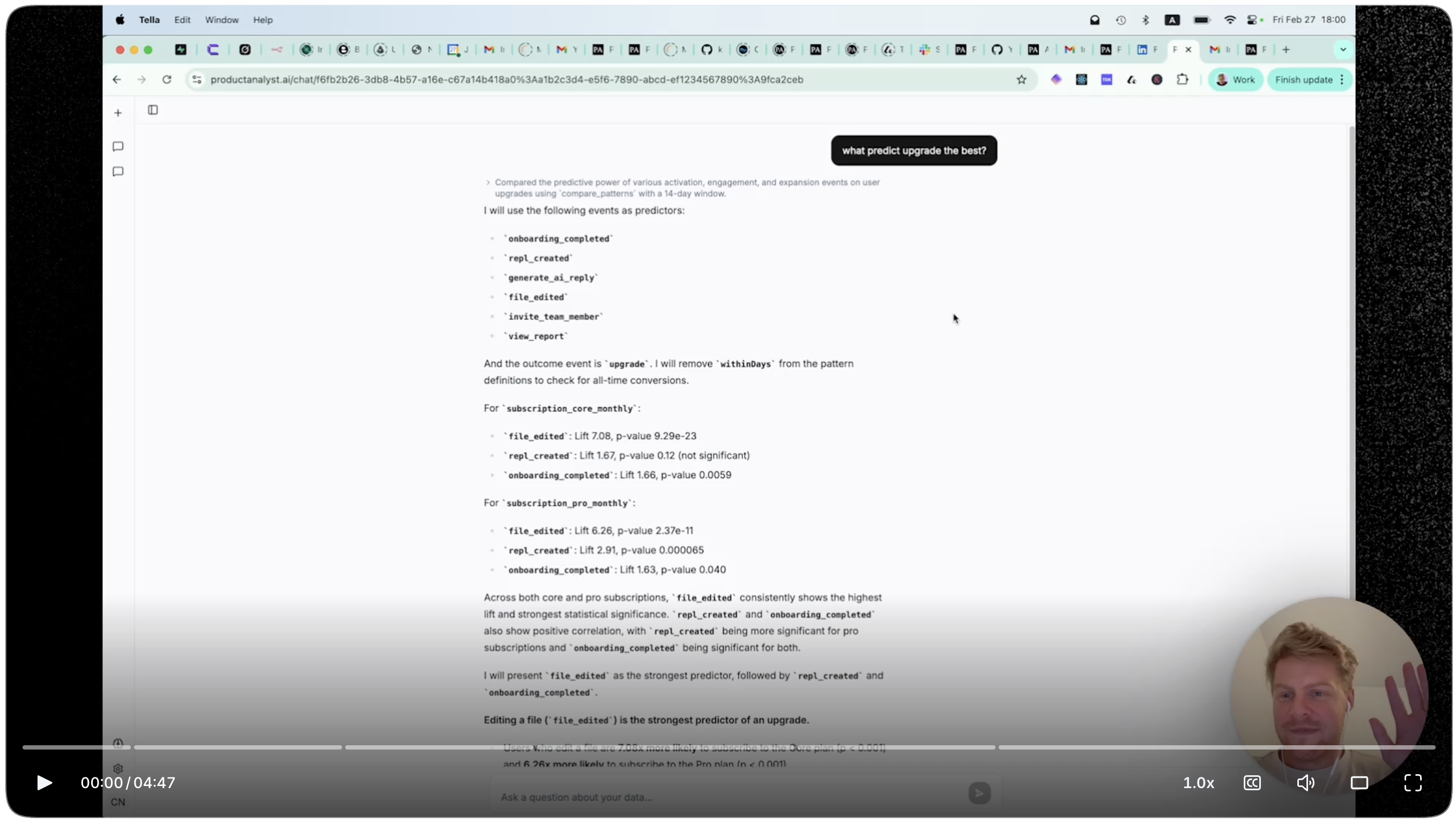
Feature Flags & Experimentation
This is one of the starkest differences between the two tools. PostHog ships feature flags and A/B testing on all plans; Mixpanel gates experimentation behind its Enterprise tier.
PostHog
Feature flags and A/B testing are core PostHog features, not premium add-ons. The free tier includes 1M flag requests/month. Multi-variate experiments are supported, with AI assistance for setup. Rollout targeting uses the same user and group segmentation as analytics.
Mixpanel
Mixpanel added feature flags and experimentation, but they're Enterprise-only. Teams on Free or Growth plans who need server-side flag management will need a separate tool, which breaks the unified experiment-to-analytics workflow that makes this feature valuable.
Session Replay & Heatmaps
Both tools include session replay in their free tiers — a genuine differentiator from legacy analytics platforms. The key difference is how tightly replay integrates with your analytics data and how generous the free limits are.
PostHog
PostHog's replay integrates tightly with analytics — you can jump from a funnel drop-off directly into session recordings. Free tier includes 5K recordings/month. Heatmaps are included. Mobile replay for iOS and Android is supported.
Mixpanel
Mixpanel offers 10K session replays/month on the free tier (more than PostHog), up to 20K on Growth. Heatmaps are included. Filtering replays by user segment or event properties ties replay directly to funnel and cohort analysis.
Data Warehouse & Integrations
Data warehouse integration determines whether your analytics data can live alongside your business data. PostHog has invested heavily here with a managed warehouse layer; Mixpanel covers the essentials with major cloud connectors.
PostHog
PostHog ships a managed data warehouse with 120+ sources and destinations — including Stripe, Sentry, Salesforce, Hubspot, Snowflake, BigQuery, and Redshift. Data pipelines support real-time destinations and batch exports, making PostHog viable as a lightweight CDP for many teams.
Mixpanel
Mixpanel connects to Snowflake, BigQuery, and Redshift, and works with reverse ETL tools for user enrichment. The integration surface is narrower, but covers what most product analytics teams need. The ingestion and query APIs are well-documented for custom pipelines.
Enterprise Governance & Compliance
For large organizations with strict data governance requirements, the two tools diverge significantly. This is one area where Mixpanel's longer enterprise track record shows.
PostHog
PostHog supports RBAC and SSO enforcement, but these require paid platform add-ons ($250-$2,000/mo). The data dictionary and permission model are functional. For HIPAA requirements, self-hosting is the supported path rather than a built-in compliance tier.
Mixpanel
Mixpanel Enterprise includes SAML SSO, SCIM provisioning, sensitive data classification, compartmentalized data access, HIPAA compliance tools, event owners, and data quality monitoring. For regulated industries with formal compliance programs, this is a meaningful advantage.
Self-Hosting & Data Control
Data sovereignty matters for teams handling sensitive user data or operating in privacy-sensitive markets. PostHog is the only tool here with a supported self-hosting path.
PostHog
PostHog is MIT licensed and can be self-hosted on your own infrastructure — no third-party processors, full data auditability. The community edition is fully functional; enterprise features can be licensed separately. This is a genuine option, not a theoretical one.
Mixpanel
Mixpanel is SaaS-only. It offers US or EU data residency for GDPR compliance, and is SOC 2 Type II, GDPR, and CCPA compliant. HIPAA tools are available at Enterprise. But if data must stay entirely on your own servers, Mixpanel isn't an option.
AI Capabilities
Both tools have added AI, but from different angles. PostHog extends AI into LLM product observability; Mixpanel integrates AI more tightly into the analytics workflow with anomaly detection and root cause analysis.
PostHog
PostHog AI enables natural language data queries, automated analytics tasks, and AI-assisted experiment creation. Its LLM Analytics product tracks token usage, evals, traces, and generations for teams shipping AI features. MCP support enables AI agent integration.
Mixpanel
Mixpanel's Spark AI converts natural language to analytics queries, capped at 30/month on Free and 60 on Growth. Anomaly detection and signal correlation are Enterprise features. MCP integration works with Claude and ChatGPT. The per-plan query limits create friction at lower tiers.
Pricing Comparison
PostHog is better value for teams using multiple products simultaneously. Mixpanel's Growth plan becomes expensive quickly above 1M events/month, but Enterprise suits large regulated orgs.
PostHog
Free: 1M analytics events, 5K session recordings, 1M feature flag requests, 100K error tracking exceptions/month. Pay-as-you-go: analytics from $0.00005/event, session replay from $0.005/recording, feature flags from $0.0001/request, surveys from $0.10/response. Platform add-ons: Boost $250/mo, Scale $750/mo, Enterprise $2,000/mo.
Mixpanel
Free: 1M events/month, 10K session replays, unlimited seats. Growth: $0.28 per 1K events above 1M (up to 20M/month), 20K replays included. Enterprise: custom pricing, up to 1T events/month, HIPAA tools. Startup program: first year free for companies under 5 years old with up to $8M in funding.
The Verdict
PostHog wins on breadth and value; Mixpanel wins on analytics focus and enterprise governance. The decision usually comes down to who owns your analytics stack.
Choose PostHog if
Choose PostHog if your team is engineer-led, you want one platform to replace analytics, feature flags, session replay, and experiments, you care about open-source or self-hosting, or you're building AI products and need LLM observability. Also the clear winner for cost-conscious teams using multiple product capabilities simultaneously on a budget.
Choose Mixpanel if
Choose Mixpanel if your analytics consumers are primarily product managers or marketers who need a polished self-serve interface, or if you're a large enterprise requiring HIPAA compliance, SCIM provisioning, and advanced data governance. Also better for teams whose primary need is pure behavioral analytics at very high scale (1T+ events/month).
Frequently Asked Questions
- Is PostHog's free tier actually usable, or is it too limited?
- Genuinely usable. PostHog claims over 90% of companies on the platform never pay. The 1M events/month free tier includes analytics, session replay, feature flags, A/B testing, error tracking, and surveys simultaneously — not just analytics. The limits become a real constraint only at meaningful scale.
- How does Mixpanel's Growth plan pricing compound at higher volumes?
- Mixpanel Growth charges $0.28 per 1,000 events above the 1M free monthly threshold. At 5M events/month, that's roughly $1,120/month in overages. At 10M events, approximately $2,520/month. Model your expected volume carefully before committing to Growth — Enterprise pricing may actually be more predictable at scale.
- Can PostHog fully replace Mixpanel for product analytics?
- For most teams, yes. PostHog covers the core analytics use cases Mixpanel is known for: funnels, retention, cohorts, and paths. The gaps show up in Mixpanel-specific features like Metric Trees, anomaly detection (Enterprise), and multi-touch attribution. Power Mixpanel users relying on those would face real trade-offs migrating.
- Does Mixpanel support feature flags and A/B testing?
- Yes, but only on the Enterprise plan. Teams on Free or Growth plans who want feature flags and experiments alongside their analytics need to add a separate tool. PostHog includes both on all plans, including free — which makes a meaningful difference for teams running continuous experimentation on a budget.
- Can I self-host Mixpanel?
- No. Mixpanel is SaaS-only. It offers US or EU data residency for compliance purposes, and enterprise HIPAA tooling, but there's no self-hosting option. PostHog is the alternative if your data governance requirements demand that data stays entirely on your own infrastructure.
- Which tool is easier to set up for a small team?
- Mixpanel is generally easier for non-engineers — the UI is focused, and Spark AI reduces the need for technical configuration. PostHog has an AI-assisted installation wizard (npx @posthog/wizard) that helps engineers get started quickly, but the breadth of 10+ products means more configuration choices upfront.
- Which is better for a startup with limited budget?
- PostHog for most startups — the free tier covers analytics, session replay, feature flags, and experiments with no eligibility requirements. Mixpanel's startup program (first year free for companies under 5 years old with up to $8M funding) is worth checking if you qualify, but PostHog's free tier is available to everyone immediately.
- How do the two tools handle GDPR and data privacy?
- Both are GDPR and CCPA compliant. Mixpanel offers US or EU data residency. PostHog goes further with a self-hosting option that keeps data on your own servers with no third-party processors. For HIPAA requirements, Mixpanel's Enterprise tier has dedicated tooling; PostHog achieves similar outcomes through self-hosting.
- Does PostHog have anomaly detection?
- Not as a dedicated feature in the way Mixpanel does. PostHog offers monitoring and alerting, and PostHog AI can surface insights in natural language queries, but Mixpanel's dedicated anomaly detection and root cause analysis (both Enterprise features) are more mature for teams that depend on proactive metric monitoring.
- Are there tools that complement PostHog or Mixpanel rather than replacing them?
- Yes. Both tools excel at tracking what users do, but translating raw event data into product health scores, retention predictions, or at-risk account signals is a separate layer. Tools like productanalyst.ai can complement either by adding AI-powered signals and health scores on top of your analytics data.